

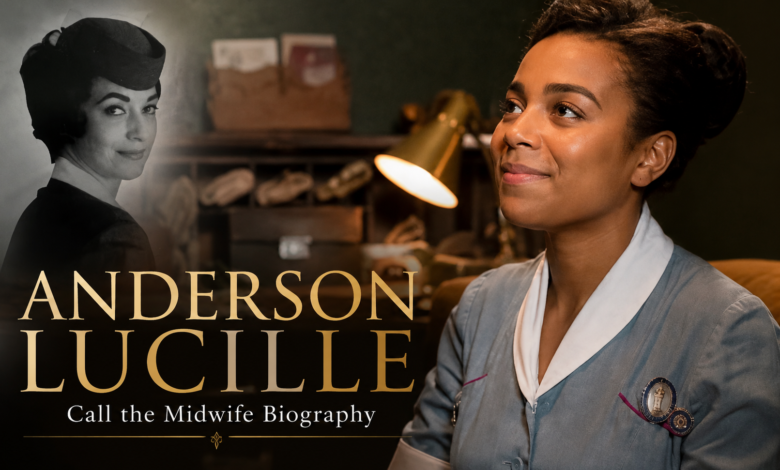
Lucille Anderson, more commonly known as Nurse Lucille Anderson, is a fictional character from the popular British period drama Call the Midwife. Introduced in the show’s seventh season, Lucille became one of Nonnatus House’s most important midwives and one of the series’ most prominent Caribbean characters.
Played by British actress Leonie Elliott, Lucille arrives in London from Jamaica during the early 1960s. Her storyline explores professional ambition, migration, racism, friendship, love, marriage, and the experience of building a new life far from home.
Although Lucille Anderson is not a real historical person, her story closely reflects the experiences of Caribbean nurses who came to Britain during the postwar period to work for the expanding National Health Service. Through Lucille, Call the Midwife examines a period in British history when thousands of people from the Caribbean joined the country’s workforce and communities.
Who Is Anderson Lucille?
Anderson Lucille is a Jamaican nurse and midwife in Call the Midwife. She joins Nonnatus House in 1963 and becomes part of the team serving families in London’s East End.
The character is portrayed as intelligent, compassionate, disciplined, and professionally ambitious. From her first appearance, Lucille is presented as someone who takes her responsibilities seriously while maintaining a strong sense of dignity and independence.
Unlike some characters who are introduced gradually through family connections in Poplar, Lucille arrives as an outsider. She traveled from Jamaica to Britain to continue her nursing career, and her arrival lets the series explore the experiences of Caribbean healthcare workers in Britain.
Leonie Elliott portrays Lucille, who joined the regular cast in Season 7.
Lucille Anderson’s Birth and Early Life
According to the character’s background in Call the Midwife, Lucille was born in Mandeville, Jamaica, in 1940.
She grew up in Jamaica in a relatively comfortable and educated household. Her father is portrayed as a teacher, while her mother manages the family home.
Lucille’s upbringing helps explain several aspects of her personality. Education, professionalism, and personal responsibility shape her character, and she enters adulthood with ambitions beyond simply finding employment.
Before becoming a nurse, Lucille worked as a librarian. Her decision to pursue nursing reflects her determination to develop a professional career and use her education in a meaningful way.
Her Jamaican background remains an important part of her identity throughout the series, even after she settles in Britain.
Why Lucille Leaves Jamaica
Anderson Lucille’s decision to travel to Britain is a defining moment in her biography.
During the 1950s and 1960s, Britain recruited workers from across the Caribbean and other parts of the Commonwealth to help address labor shortages. Caribbean women played an important role in nursing.
Lucille’s journey therefore represents something larger than one woman’s career. Her story reflects the migration of Caribbean professionals who traveled to Britain seeking opportunities while facing an unfamiliar society.
Lucille Anderson’s Education and Nursing Career
Lucille arrives in Britain as an educated, professionally trained nurse.
She travels to England in 1960 to continue her nursing training and eventually becomes qualified as a midwife. By the time she reaches Nonnatus House, she already has professional experience and understands the responsibilities of caring for mothers and babies.
Her career is not portrayed as effortless.
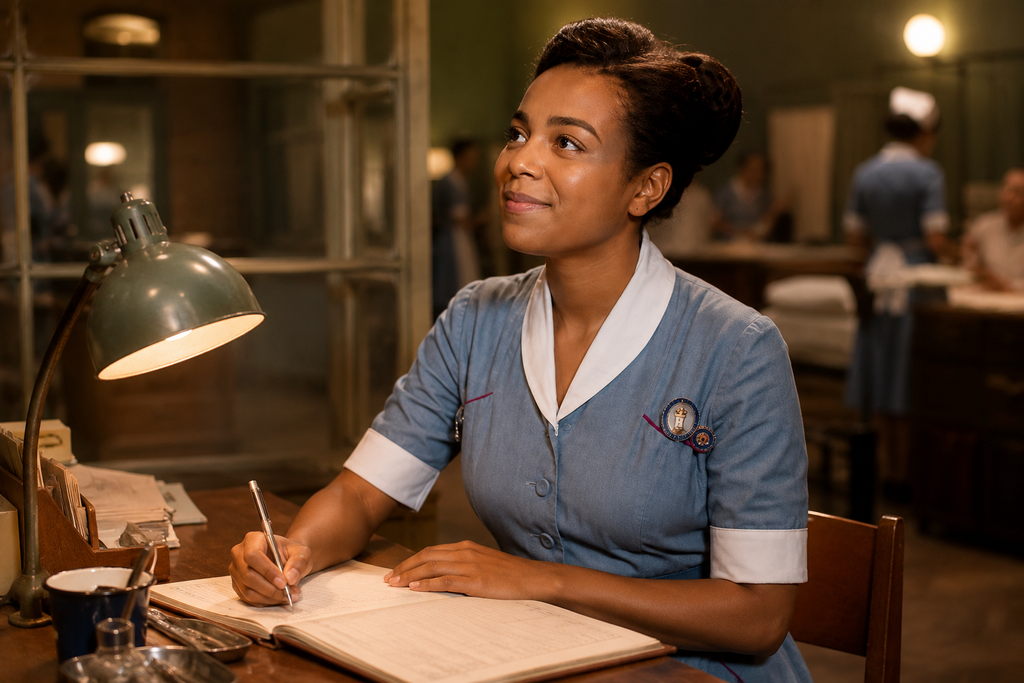
Lucille must frequently prove herself in an environment where prejudice exists alongside professional expectations. Her competence is obvious, but some patients and members of the public treat her differently because she is Black and Caribbean.
The contrast between Lucille’s professional ability and the prejudice she encounters becomes an important theme in her story.
Joining Nonnatus House
Lucille first appears in Call the Midwife during Season 7, set in 1963.
She is introduced during the harsh winter known as the “Big Freeze.” She arrives late because of the weather and is initially unwell, yet she is soon called upon to assist with a difficult birth.
That introduction establishes one of her central characteristics: Lucille is committed to her work even when circumstances are difficult.
At Nonnatus House, she gradually develops relationships with the other nurses, midwives, and sisters. Her professional approach earns respect, although adapting to life in Poplar takes time.
Lucille Anderson and Racism
One of the most significant elements of Anderson Lucille storyline is her experience with racism.
The series does not present her as someone who is defined entirely by discrimination. Instead, racism becomes one of several challenges she has to navigate while building a career and personal life in Britain.
In her early episodes, Lucille encounters patients and members of the public who question or reject her because of her race.
These experiences affect her emotionally, but they do not erase her professionalism. She continues to provide medical care and focus on her patients’ needs.
Her storyline also highlights the broader difficulties Caribbean nurses faced in Britain during the period.
Lucille’s experiences are particularly significant because she is not simply portrayed as a migrant looking for work. She is a trained professional who expects to be treated according to her qualifications and responsibilities.
Lucille Anderson’s Personality
Her calm, thoughtful personality often defines Lucille.
She can be reserved when she first meets people, but she becomes warmer as relationships develop. She is also highly conscientious and tends to approach professional situations with seriousness.
Her compassion is especially visible when she works with vulnerable mothers and families.
At the same time, Lucille is not portrayed as perfect. She can be stubborn, emotionally guarded, and occasionally overwhelmed by the pressures surrounding her.
These qualities make her more than a historical symbol. She becomes a fully developed character whose professional responsibilities exist alongside ordinary hopes, fears, and relationships.
Lucille Anderson and Her Friends at Nonnatus House
Anderson Lucille gradually becomes an important member of the Nonnatus House community.
She develops friendships with several members of the nursing team, including Valerie Dyer, Trixie Franklin and Phyllis Crane.
Her relationships with her colleagues help her feel less isolated after arriving in Britain.
The friendships also show different sides of her personality. At work, Lucille is disciplined and focused. Around people she trusts, she becomes more relaxed and emotionally open.
Her friendships become particularly important when she faces difficult personal circumstances later in the series.
Lucille Anderson and Cyril Robinson
One of the most important relationships in Lucille Anderson’s biography is her romance with Cyril Robinson, played by Zephryn Taitte.
Cyril is an immigrant from British Guiana who is building a new life in Britain. His background gives him something in common with Lucille, even though their experiences differ.
Their relationship develops gradually rather than becoming an immediate romance.
Cyril spends a long time courting Lucille, and their relationship eventually becomes one of the central love stories in Call the Midwife.
Their connection matters because both characters are immigrants trying to establish themselves in Britain while grappling with questions of identity, belonging, and prejudice.
Lucille Anderson’s Marriage
Lucille and Cyril eventually marry on Boxing Day during Season 11.
Their wedding represents an important turning point in Lucille’s story.
By this stage, she has established herself professionally and developed a deep connection to the community around Nonnatus House. Marriage gives her another form of stability, but it also introduces new emotional challenges.
Lucille and Cyril’s marriage is not presented as a perfect fairy tale. The couple faces financial pressures, housing difficulties, discrimination, and personal tragedy.
Nevertheless, their relationship remains central to both characters’ development.
Lucille Anderson and Children
Anderson Lucille and Cyril hope to start a family.
Their storyline includes a heartbreaking miscarriage, which becomes one of the most emotional moments in Lucille’s later story.
The miscarriage has a profound effect on Lucille. Rather than moving past it quickly, the series uses it to explore grief and the different ways people respond to loss.
Lucille and Cyril support each other, but the experience contributes to Lucille’s increasing emotional distress.
The series does not establish that Lucille has biological children who survive to adulthood.
Lucille Anderson’s Personal Life
Outside her nursing career, Lucille’s personal life largely revolves around her relationships with Cyril, her colleagues, and the wider Poplar community.
She maintains a strong connection to Jamaica even after establishing herself in Britain.
Her identity is never reduced to a single label. She is simultaneously Jamaican, British-based, a nurse, a wife, a friend and a member of the Nonnatus community.
This complexity is one reason her character became significant within the series.
Lucille’s personal struggles also become increasingly important as the story progresses. The combination of professional pressure, racism, grief, and homesickness affects her ability to remain happy in Poplar.
Why Lucille Anderson Leaves Poplar
Lucille’s story eventually takes her away from Nonnatus House.
In Season 12, after increasing emotional distress, Lucille decides to return to Jamaica.
Her departure is not simply a career decision. It is connected to everything she has experienced in Britain, including the loss she and Cyril suffered and the emotional strain that followed.
Returning to Jamaica gives the character a chance to reconnect with the country and culture she came from.
Cyril remains in Britain for a time, creating a difficult separation between the married couple.
Lucille’s departure is therefore one of the more significant changes in the show’s later storyline.
Anderson Lucille’s Net Worth
There is no official net worth figure for Anderson Lucille.
This is because Lucille is a fictional character, not a real celebrity. The television series does not establish a specific amount of personal wealth for her.
Similarly, there is no reliable basis for assigning her a salary or calculating her financial assets.
It is more accurate to discuss Lucille in terms of her profession and lifestyle than to attach an invented net-worth figure to her.
Lucille Anderson’s Social Media
Anderson Lucille does not have personal social-media accounts because she is a fictional character.
Social-media profiles associated with Call the Midwife, its cast, or its production are separate from the character herself.
Fans may find discussions, photographs and fan-created content about Lucille online, but these should not be confused with official accounts belonging to the fictional nurse.
The Actress Behind Lucille Anderson
Leonie Elliott plays Anderson Lucille, a British actress born in London in 1988.
Elliott began acting as a child and later trained professionally. Before becoming widely recognized as Lucille, she appeared in productions including Wondrous Oblivion, Danny and the Human Zoo, Black Mirror and Casualty.
Her casting as Lucille was particularly meaningful because Elliott has Jamaican family connections. She has spoken publicly about feeling an immediate connection with the character because their families came from the same part of Jamaica.
That connection helped inform Elliott’s approach to the role.
Through her performance, Lucille became one of the show’s recognizable characters and an important representation of Caribbean nursing history.
Why Lucille Anderson Matters to Call the Midwife
Lucille’s importance extends beyond her individual storyline.
Her arrival allowed Call the Midwife to explore Caribbean nurses’ contributions to Britain’s healthcare system.
The character also expanded the show’s Depiction of postwar Britain. The East End shown in the series is not culturally isolated; it is a changing community shaped by migration and social transformation.
Lucille’s experiences demonstrate that professional achievement did not necessarily protect Caribbean immigrants from prejudice.
At the same time, her story is not solely about discrimination. The series gives her friendships, romance, professional ambitions and personal choices, allowing audiences to see her as an individual.
Lucille Anderson’s Legacy in the Series
Although Anderson Lucille eventually leaves Poplar, her impact on Call the Midwife remains significant.
She represents a generation of Caribbean women who traveled to Britain with professional qualifications and ambitions.
Her relationship with Cyril also became an important part of the show’s exploration of immigrant life and interracial relationships during the 1960s and 1970s.
The character’s departure is emotional precisely because audiences have watched her transform from a newcomer into an established member of the Nonnatus family.
Lucille Anderson’s story ultimately connects personal history with a larger social history.
Where Is Lucille Anderson Today?
In Call the Midwife, Lucille Anderson returns to Jamaica after leaving Poplar in Season 12.
The series does not provide a complete account of her later life.
Therefore, treat claims about her current age, occupation, wealth, or exact circumstances after returning to Jamaica cautiously unless the show specifically establishes them.
As a fictional character, Lucille’s “life today” depends on the continuing narrative of Call the Midwife rather than real-world events.
Frequently Asked Questions
Who is Anderson Lucille?
Anderson Lucille, more commonly called Lucille Anderson, is a fictional Jamaican nurse and midwife in the BBC drama Call the Midwife. Actress Leonie Elliott plays her.
When did Lucille Anderson first appear in Call the Midwife?
Lucille Anderson first appeared in Season 7 of Call the Midwife, which is set in 1963.
Where was Lucille Anderson born?
Lucille is portrayed as having been born in Mandeville, Jamaica, in 1940.
Who plays Lucille Anderson?
British actress Leonie Elliott plays Lucille Anderson. Elliott joined the regular cast of Call the Midwife for Season 7.
Who is Lucille Anderson married to?
Lucille Anderson marries Cyril Robinson, a character played by Zephryn Taitte. Their wedding takes place on Boxing Day during Season 11.
Does Lucille Anderson have children?
Lucille and Cyril hope to have a child, but they experience a miscarriage. The series does not establish that the couple has any surviving biological children.
Why does Lucille Anderson leave Call the Midwife?
Lucille returns to Jamaica in Season 12 after experiencing increasing emotional distress following difficult personal experiences in Poplar. Her departure marks an important change in the character’s story.
Is Lucille Anderson a real person?
No. Lucille Anderson is a fictional character created for Call the Midwife. Her storyline, however, draws on the real historical experiences of Caribbean nurses who came to Britain during the postwar period.
Final Thoughts
Lucille Anderson is one of Call the Midwife’s most significant fictional characters because her story combines professional ambition with the realities of migration, prejudice, love, and belonging.
From her arrival in London as a Jamaican-trained nurse to her years at Nonnatus House, marriage to Cyril Robinson, and eventual return to Jamaica, Lucille’s journey reflects Britain’s changing social landscape in the 1960s.
Leonie Elliott’s performance helped make the character memorable, while the show’s historical setting gives Lucille’s personal story a wider context. Although she is fictional, her experiences invite viewers to consider the real contributions made by Caribbean healthcare workers and the challenges many faced while building new lives in Britain.





One Comment