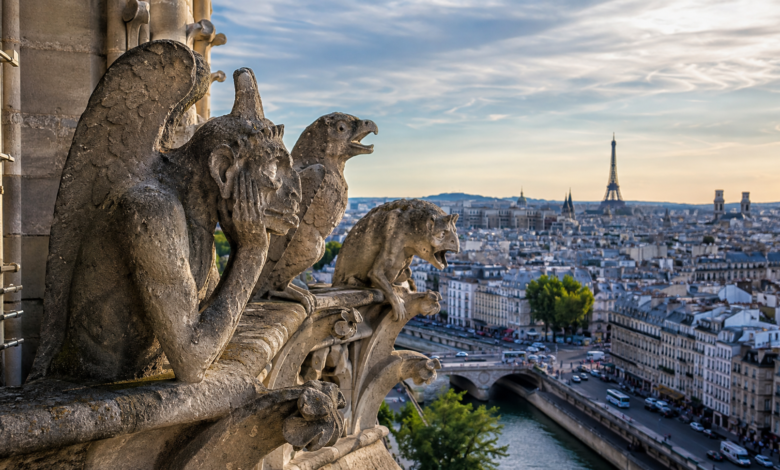
The Notre Dame gargoyles in Paris are among the most recognisable architectural features of the medieval cathedral. Their strange faces, animal-like bodies, wings, horns, and exaggerated expressions have fascinated visitors for generations. Often photographed against the Paris skyline, these stone figures have become almost as culturally recognisable as the cathedral itself.
Yet the story behind the gargoyles is more complicated than their appearance suggests. Some of the figures commonly called “gargoyles” at Notre Dame are technically grotesques or chimaeras. In contrast, the true gargoyles served an important practical purpose: carrying rainwater away from the cathedral’s walls.
Unlike a celebrity biography, the subject here is not a person with a birth date, family, career, spouse, or social-media presence. The phrase Notre Dame gargoyles Paris refers to architectural sculptures connected with Notre-Dame de Paris, a historic Gothic cathedral on the Île de la Cité.
What Are the Notre Dame Gargoyles in Paris?
Gargoyles are architectural waterspouts designed to move rainwater away from a building. At Notre Dame, these stone features became part of the cathedral’s Gothic architecture, combining practical engineering with dramatic sculptural design.
The word “gargoyle” generally refers to a creature-like stone figure projecting from a building. Water traditionally flows through the figure and exits through its mouth, keeping rainwater from running directly down the masonry.
At Notre Dame, however, not every frightening-looking creature is technically a gargoyle.
Gargoyles vs Grotesques and Chimaera
This distinction is important when discussing Notre Dame.
A true gargoyle has a functional purpose as a waterspout. A sculpted creature that does not carry water is more accurately described as a grotesque or chimaera.
The famous crouching, snarling, winged creatures often photographed around Notre Dame are therefore not necessarily original medieval gargoyles—many of the best-known figures date to the cathedral’s nineteenth-century restoration.
This mixture of medieval architecture and later sculpture is one reason the subject can be confusing.
The History of Notre Dame Gargoyles Paris
Construction of Notre-Dame de Paris began in the 12th century, as Gothic architecture developed across France. Construction began in approximately 1163, during the reign of Louis VII, and continued for generations.
The cathedral became a defining religious and architectural landmark of medieval Paris.
Its enormous scale required new approaches to structural engineering. Gothic builders used pointed arches, ribbed vaults, flying buttresses, and other techniques to create taller, more open buildings.
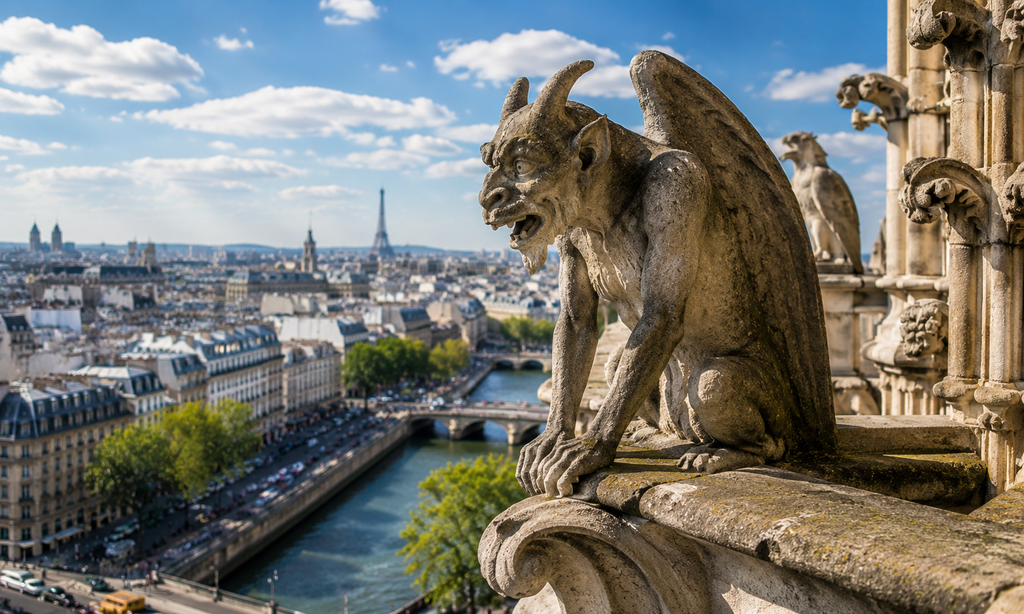
Why Water Drainage Mattered
Rainwater was a serious architectural problem for a large stone building.
Without controlled drainage, water could run down walls and seep into masonry joints. Over time, repeated exposure to moisture could contribute to deterioration.
Gargoyles provided a solution. Instead of allowing rainwater to pour directly from the roof onto the walls, the waterspouts projected outward and directed the water away from the structure.
Their unusual shapes therefore served an engineering purpose while also contributing to the cathedral’s visual identity.
Were the Notre Dame Gargoyles Really Medieval?
This is one of the most interesting facts about the subject.
Many people assume that every famous creature surrounding Notre Dame dates back to the Middle Ages. That is not the case.
The cathedral underwent significant restoration during the nineteenth century, particularly under architect Eugène Viollet-le-Duc and his collaborators.
During this restoration, numerous sculptures and architectural features were repaired, replaced or newly created.
Eugène Viollet-le-Duc and the Restoration
Viollet-le-Duc became one of the most influential figures in restoring medieval architecture in France.
His work at Notre Dame took place during the nineteenth century, when European interest in medieval architecture was growing. Rather than preserving every surviving fragment exactly as it was, nineteenth-century restoration sometimes recreated features based on interpretations of medieval design.
The famous chimaera figures on the upper levels of Notre Dame are largely connected to this restoration period.
As a result, the creatures visitors recognise today represent both the cathedral’s medieval history and the nineteenth-century imagination of what Gothic architecture should look like.
Why Did Notre Dame Have Such Strange Creatures?
The frightening appearance of the sculptures has encouraged many theories.
Some interpretations connect medieval grotesques with religious ideas about evil, sin, demons and the contrast between the sacred interior of a church and the chaotic world outside.
Others emphasise their decorative and humorous qualities.
Medieval Gothic architecture frequently included fantastic creatures, animals, hybrid beings and exaggerated human forms. Their presence did not necessarily carry a single universal symbolic meaning.
A Mixture of Fear, Humour and Imagination
The creatures at Notre Dame Gargoyles Paris can appear threatening, but some also look playful or absurd.
This mixture is part of their appeal.
A creature with a twisted face might look frightening from one angle and almost humorous from another. Such visual variety reflects the imaginative character of Gothic sculpture.
It is therefore risky to claim that every individual figure had one specific hidden meaning.
The Famous Notre Dame Chimaera
Among the most recognisable sculptures are the figures often described as Notre Dame Gargoyles Paris chimaeras.
They sit high above the city, seemingly watching over Paris from the cathedral’s upper levels.
Their elevated position also contributes to their modern fame. Visitors looking upward can see the creatures against the sky, while photographs frequently place them alongside famous Paris landmarks.
The Stryge
Perhaps the most famous figure is the Stryge, sometimes described in English as a brooding or contemplative demon-like creature.
The figure became especially famous after nineteenth-century photographs of Notre Dame Gargoyles Paris circulated widely.
Its pose is memorable: it appears to lean forward with a hand near its face while looking across the city.
The Stryge has become one of the visual symbols associated with Notre Dame.
Notre Dame Gargoyles and Victor Hugo
The creatures also became connected with French literature.
Victor Hugo’s 1831 novel The Hunchback of Notre-Dame, known in French as Notre Dame Gargoyles Paris, helped transform the cathedral into an internationally recognised cultural symbol.
The novel focuses on the cathedral and the fictional characters Quasimodo and Esmeralda, portraying Notre Dame as an important presence in the story.
Although Hugo’s novel predates the famous nineteenth-century restoration sculptures, it played a major role in encouraging public appreciation of the cathedral and its medieval architecture.
The Connection With Quasimodo
Modern popular culture often connects Quasimodo with gargoyles.
Later adaptations, including film and animation, strengthened the association.
However, Quasimodo is a fictional character, while the stone creatures on Notre Dame are architectural sculptures. They should not be treated as historical characters or as representations of one specific person.
The 2019 Notre Dame Fire
The history of the Notre Dame gargoyles took another dramatic turn on 15 April 2019, when a devastating fire severely damaged the cathedral.
The blaze destroyed much of the roof and caused the cathedral’s spire to collapse.
The disaster generated international attention because Notre Dame was not simply a religious building. It was also a major symbol of French history, Parisian culture and Gothic architecture.
What Happened to the Gargoyles?
Because many of the sculptures were positioned around the cathedral’s exterior, their condition became an important concern during the restoration.
Some architectural elements had already been removed for conservation or restoration work, while other areas of the building were affected by the fire and the subsequent emergency response.
The survival of individual sculptures and architectural elements varied, and restoration required extensive investigation and conservation work.
Notre Dame Restoration and the Return of Visitors
Following the 2019 fire, France undertook a major reconstruction and restoration effort.
The project involved architects, engineers, craftspeople, historians, conservators and other specialists.
The restoration was not simply about rebuilding damaged sections. Experts also had to determine how to preserve the cathedral’s historic appearance and structural integrity.
Why the Gargoyles Matter
The gargoyles and chimaeras matter because they contribute to the cathedral’s visual character.
They are not merely decorative objects. They communicate Notre Dame’s layered history, from medieval construction through nineteenth-century restoration and into the modern conservation era.
For visitors, they also provide a human connection to the craftsmanship behind the enormous building.
Are the Notre Dame Gargoyles Real People?
No.
The creatures are sculptures, not representations of identifiable historical people.
Some have human-like faces, but they were created as fantastic architectural figures.
Their appearance can make them seem almost alive, especially in close-up photographs, but no reliable historical basis supports treating the famous creatures as portraits of particular individuals.
Notre Dame Gargoyles in Popular Culture
The gargoyles have become part of Paris’s visual language.
They appear in photographs, travel publications, documentaries, artwork and popular representations of the city.
Their popularity comes partly from their contrast with the elegant Parisian skyline.
From a distance, Notre Dame can appear solemn and monumental. Up close, the strange stone creatures introduce an element of mystery and theatricality.
This combination has made them particularly attractive to photographers and storytellers.
The Meaning of Gargoyles at Notre Dame
No single explanation accounts for every gargoyle or grotesque at Notre Dame.
We can consider their functions and interpretations in several ways.
Practical Function
For genuine gargoyles, the primary function was to drain water.
The sculptures helped move rainwater away from the building.
Decorative Function
The figures also enriched the cathedral’s exterior.
Gothic architecture was not limited to geometric forms and religious imagery. It could incorporate imaginative creatures and elaborate details.
Symbolic Interpretations
Some grotesque creatures have been interpreted through medieval religious concepts involving evil, temptation and the boundary between the sacred and the profane.
However, modern explanations sometimes assign meanings that historical evidence cannot firmly establish.
It is better to distinguish documented architectural functions from later interpretations.
How Old Are the Notre Dame Gargoyles?
The answer depends on which sculptures you mean.
Notre Dame itself is primarily a medieval cathedral, with construction beginning in the twelfth century.
However, many of the famous creature sculptures associated with the cathedral were produced or significantly restored during the nineteenth century.
Therefore, saying that all the famous Notre Dame gargoyles Paris are nearly 900 years old would be misleading.
The building is medieval, but some of the sculptures most closely associated with its modern image are considerably newer.
Do the Gargoyles Have Names?
Most of the creatures do not have universally established individual names.
The Stryge is the notable exception because it became particularly famous and is frequently identified separately.
Many other figures are simply described by their appearance or architectural category.
This is another reason to be cautious with internet lists that give dramatic names or elaborate backstories to every creature.
Notre Dame Gargoyles and Tourism
Before the 2019 fire, the cathedral attracted millions of visitors.
The exterior sculptures were an important part of the visitor experience, particularly for people interested in Gothic architecture, medieval history and photography.
The gargoyles offered a different perspective from the cathedral’s famous interior.
Rather than viewing the building from street level, visitors could see its upper architecture and Paris from above.
Do the Gargoyles Have Social Media Accounts?
The Notre Dame gargoyles Paris are architectural sculptures and do not have personal social-media accounts.
Individual photographers, historians, museums, tourism organisations, and cultural institutions may publish photographs and information about them online. Still, people should not confuse these accounts with official personal profiles belonging to the sculptures.
Net Worth of the Notre Dame Gargoyles
The gargoyles do not have a personal net worth.
They are part of the architectural and cultural heritage of Notre-Dame de Paris, not privately owned celebrity objects.
Their cultural importance is considerable, but assigning an individual monetary value to the famous sculptures would not accurately represent their historical significance.
Why Are the Notre Dame Gargoyles Still Famous?
Notre Dame Gargoyles Paris, Several factors contribute to their enduring popularity.
First, they are visually distinctive. Their exaggerated faces and unusual forms immediately attract attention.
Second, they are connected with one of the world’s most famous Gothic cathedrals.
Third, the sculptures occupy a space between history, architecture and legend.
Finally, photography, literature, cinema, and tourism have reinforced their image.
For many people, seeing a gargoyle above the Paris skyline is an unmistakable reminder that they are looking at Notre Dame.
Life Today: The Continuing Legacy of Notre Dame Gargoyles
Notre Dame Gargoyles Paris, Today, the Notre Dame gargoyles remain part of the cathedral’s wider cultural legacy.
The restoration of Notre Dame has renewed international interest in its architecture and craftsmanship.
The sculptures also remind modern audiences that historic buildings are rarely frozen in a single moment in time. Notre Dame is the product of medieval construction, centuries of alteration, nineteenth-century restoration, twentieth-century conservation and twenty-first-century reconstruction.
The famous stone creatures embody that layered history.
They may look ancient, mysterious, and timeless, but their story is a combination of medieval engineering, nineteenth-century artistic reconstruction, and modern heritage conservation.
Frequently Asked Questions
What are the Notre Dame gargoyles in Paris?
Notre Dame Gargoyles Paris, They are stone architectural figures associated with Notre-Dame de Paris. True gargoyles function as waterspouts, while many famous creature sculptures are technically grotesques or chimaeras.
Are the Notre Dame gargoyles from the Middle Ages?
Not all of them. Notre Dame is a medieval cathedral, but many of the famous creature sculptures were created or reconstructed during the nineteenth-century restoration led by Eugène Viollet-le-Duc.
What is the most famous Notre Dame gargoyle?
The Stryge is arguably the most recognisable creature associated with the cathedral. It is often shown leaning forward and looking across Paris.
Why did medieval buildings use gargoyles?
True gargoyles helped direct rainwater away from stone walls. Their sculptural forms also became an important part of Gothic architectural decoration.
Are gargoyles supposed to represent demons?
Some grotesque figures can be interpreted through religious ideas about evil or the supernatural, but no single confirmed meaning applies to every creature at Notre Dame.
Did the 2019 fire destroy the Notre Dame gargoyles?
The 2019 fire severely damaged Notre Dame, but the condition and history of individual sculptures varied. Restoration and conservation efforts have focused on preserving the cathedral’s surviving historic elements and rebuilding damaged portions.
Can visitors see the Notre Dame gargoyles today?
Notre Dame Gargoyles Paris, Access to specific upper-level sculptures can depend on restoration, conservation work and visitor arrangements. The cathedral’s exterior remains an important part of the Notre Dame experience, but not every architectural feature is always accessible to visitors.