

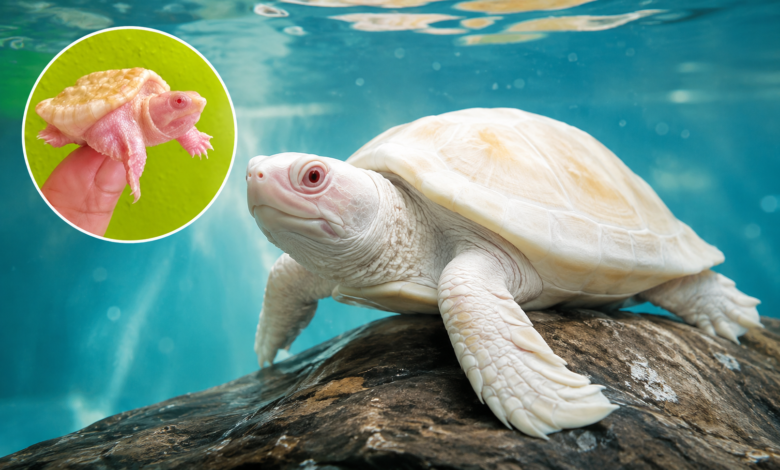
An albino turtle isn’t a celebrity or a single identifiable individual; it’s a turtle born with albinism, a rare genetic condition that significantly reduces or eliminates melanin pigmentation. Because albino turtles can have striking white, cream, or pale-yellow shells and bodies, they often attract attention in zoos, aquariums, wildlife collections, and on social media.
Unlike a conventional biography of a public figure, an albino turtle does not have a universally documented birth date, family history, education, career, or net worth. Individual albino turtles may have names given to them by their owners or caretakers, but those names and personal details are not necessarily documented publicly.
This article explores what we can reliably say about albino turtles, including their biology, appearance, genetics, lifespan, care, public interest, and the questions people commonly ask about these unusual reptiles.
What Is an Albino Turtle?
An albino turtle is a turtle with albinism, a genetic condition associated with reduced or absent melanin production. Melanin causes much of the dark pigmentation found in an animal’s skin, eyes, scales, and shell.
Because turtles normally have pigmentation ranging from dark brown and black to green, yellow, orange, or patterned combinations, the absence of normal pigmentation can create a dramatic visual difference.
Albino turtles are usually much paler than other turtles of the same species. Their shells may appear white, ivory, cream, or pale yellow, while their skin can be similarly light.
The eyes are another important feature. Many genuinely albino animals have reddish or pinkish-looking eyes because blood vessels beneath the lightly pigmented eye tissues become more visible.
Albino Turtle Real Name and Identity
No single turtle is officially known as an “Albino Turtle.”
The phrase generally describes a genetic colour condition, not a specific animal. Different species can produce albino individuals, and owners, breeders, aquariums, zoos, or online communities may give particular turtles personal names.
As a result, questions about an albino turtle’s “real name” depend on which individual you’re discussing.
Some famous individual albino turtles have appeared in online photos and videos, but identifying a particular turtle from the phrase “albino turtle” alone is unreliable.
Albino Turtle Age and Birth Date
An albino turtle does not have one specific age or birth date.
Individual turtles are born at different times depending on their species and circumstances. A captive albino turtle may have a carefully recorded hatch date, while an animal discovered in the wild may have no known birth date.
Age can sometimes be estimated through records maintained by a breeder, zoo, aquarium, veterinarian, or conservation organization. However, no reliable general method exists to determine a turtle’s exact age just by looking at it.
How Long Can Albino Turtles Live?
An albino turtle’s lifespan depends mainly on its species, health, environment, diet, genetics, and care quality.
Some turtle species can live for several decades. Some species can live much longer under favourable conditions.
Albinism itself does not automatically determine an animal’s exact lifespan. However, reduced pigmentation can create additional challenges, particularly involving the eyes and sensitivity to intense light.
Early Life and Hatching
An albino turtle begins life much like another turtle of the same species.
For many turtle species, development begins inside an egg. After incubation, a hatchling breaks through the shell and emerges as a very small version of the adult animal.
The most obvious difference may be visible from the beginning: an albino hatchling can have unusually pale skin and shell colouration.
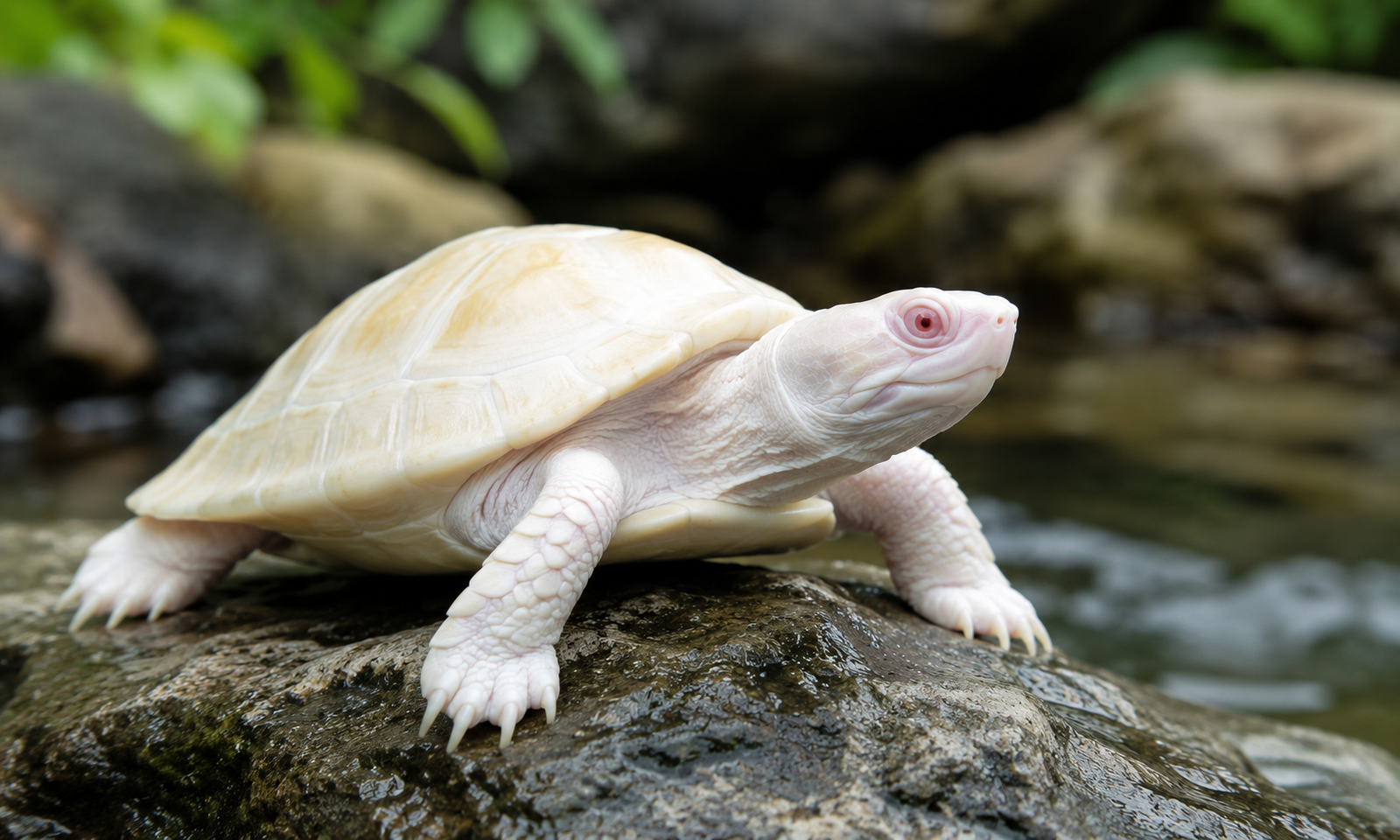
In some cases, people confuse true albinism with other forms of unusual colouration. A turtle can be naturally very pale without being completely albino.
Albino Turtle Parents and Family
No standard family tree exists for albino turtles.
An albino turtle can be born to parents that do not visibly display albinism. This is possible because genetic traits can be carried without being outwardly obvious.
The exact inheritance pattern depends on the species and the genes involved. Therefore, an albino offspring does not necessarily mean both parents were visibly albino.
Do Albino Turtles Have Albino Parents?
Not necessarily.
Genetic traits can be passed through generations without producing the same visible appearance in every animal. As a result, a normally coloured turtle may produce offspring with an unusual pigmentation condition under the right genetic circumstances.
Without documented breeding records and genetic information, however, you cannot establish an individual albino turtle’s precise family history.
Education and Development
Unlike a human celebrity, an albino turtle does not attend school or receive formal education.
Young turtles develop through natural behaviours such as feeding, swimming, hiding, basking, exploring, and responding to environmental conditions.
In captivity, caretakers may provide an environment that supports these natural behaviours. Appropriate lighting, temperature, water quality, nutrition, shelter, and space can all influence development.
Albino Turtle Career and Role
The term “career” does not traditionally apply to animals.
However, individual albino turtles can become notable because of their unusual appearance. They may be displayed in zoological institutions, educational programs, wildlife exhibits, private collections, or online media.
In these cases, their role is often educational rather than professional.
A rare-looking animal may help people learn about genetics, reptile biology, biodiversity, and the importance of responsible wildlife care.
Why Are Albino Turtles So Rare?
Albinism is uncommon because it depends on particular genetic circumstances.
The condition affects melanin production, and the likelihood of an albino offspring varies according to species and inheritance patterns.
The rarity of albino also helps explain why they attract attention. People who have seen thousands of normally colored turtles may immediately notice a white or extremely pale individual.
However, rarity does not necessarily mean that an animal is a different species.
An albino turtle remains a member of its original species.
Physical Appearance of an Albino Turtle
An albino’s appearance can be striking.
Common characteristics may include:
- Very pale or white skin
- White, cream, or yellowish shell
- Reduced pigmentation around the head and limbs
- Light-colored claws
- Pale eyes
- Pink or reddish-looking eyes in some individuals
The exact appearance varies according to species and the degree of pigmentation affected.
Albino Turtle Shell
The shell may be significantly lighter than the species’ normal colouration.
A turtle that would ordinarily have a dark green, brown, gray, or black shell may instead have a cream or ivory appearance.
The shell itself is still structurally a turtle shell. Albinism primarily changes pigmentation rather than turning the shell into a fundamentally different anatomical structure.
Albino Turtles and Their Eyes
One of the most recognizable features of albinism is unusual eye colouration.
Melanin normally contributes to eye pigmentation. When pigmentation is greatly reduced, underlying blood vessels can become more visible, producing pinkish or reddish tones.
This can also make albino animals more sensitive to bright light.
That does not mean every pale-eyed turtle is necessarily albino. Accurate identification requires considering the animal’s overall pigmentation and, when necessary, a professional examination.
Health and Special Challenges
Albino can face some challenges associated with reduced pigmentation.
One concern is light sensitivity. Because melanin helps protect tissues from intense light, animals with little pigmentation may be more sensitive to strong illumination.
Vision can also be affected in some albino animals.
Other health issues depend heavily on species and living conditions. Poor nutrition, unsuitable temperatures, inadequate ultraviolet lighting, poor water quality, and insufficient space can cause health problems in turtles regardless of colouration.
For captive animals, specialized veterinary care can be particularly important when unusual physical characteristics are present.
What Do Albino Turtles Eat?
An albino turtle generally follows its species’ dietary requirements.
There is no universal “albinoturtle diet.”
Some turtles are primarily herbivorous, while others consume a combination of plant material and animal-based foods. Aquatic turtles and land turtles can also have very different nutritional needs.
A suitable diet may include species-appropriate vegetables, leafy plants, insects, aquatic organisms, commercial turtle foods, or other foods depending on the animal.
Overfeeding can also cause health problems, so base feeding on species, age, size, and veterinary or husbandry guidance.
Albino Turtle Habitat
The correct habitat depends on the turtle species.
Aquatic species generally require appropriate water depth, filtration, basking areas, heating, and ultraviolet lighting. Terrestrial species require suitable land-based environments with appropriate temperature, humidity, shelter, and substrate.
Because albino may be more sensitive to intense light, their habitat should be designed carefully.
Providing a shaded area lets the animal move away from bright light when needed.
Albino Turtle in Popular Culture and Social Media
Albinos turtles have become particularly interesting to internet audiences because unusual animals can generate strong visual curiosity.
Photographs and short videos of pale or white turtles are frequently shared because they look dramatically different from the typical turtle.
Social media can therefore make an individual turtle appear famous even when very little verified information exists about its personal history.
This creates an important distinction between online popularity and documented biography.
A turtle may have thousands of views without having a publicly verified birth date, parentage, age, or ownership history.
Famous Albino Turtles
No universally recognized global celebrity equivalent of a famous human actor or musician exists among albino turtles.
Individual animals have nevertheless attracted attention through zoos, aquariums, conservation organizations, breeders, and social media.
When a particular albino turtle is described as “famous,” the claim should ideally link to a documented individual and an identifiable institution or publication.
Without those details, it would be misleading to assign a specific biography to the general term “albino turtle.”
Spouse, Partner, and Children
Questions about a turtle’s spouse, partner, or children are usually not documented in the same way as they are for human celebrities.
Turtles reproduce through mating, but people rarely record individual relationships as personal partnerships.
An individual albinos turtle may potentially reproduce if it is healthy and biologically capable of breeding. However, breeders should approach breeding responsibly, especially when rare genetic traits are involved.
Albino Turtle Net Worth
An albino turtle does not have a personal net worth in the conventional human sense.
A turtle may have monetary value in private markets, but that differs from income, assets, investments, or personal wealth.
An individual turtle’s value can vary by species, legal status, age, health, captive-breeding history, rarity, and local regulations.
Because of these differences, assigning a specific “net worth” to an albino turtle without identifying an individual and reliable documentation would be speculative.
Public Appearances
Albino can appear in educational exhibits, reptile events, aquariums, zoos, conservation programs, and online videos.
Their unusual appearance makes them useful subjects for explaining pigmentation and genetic variation.
Public displays can also create opportunities to discuss responsible wildlife ownership and the importance of protecting natural turtle populations.
Social Media Presence
No single official social media account represents all albino’ turtles.
Individual turtles may have accounts or pages created by their owners, caretakers, zoos, or animal enthusiasts.
For this reason, treat social media claims carefully. A photograph may identify an animal as “albino” without providing enough evidence to confirm its genetic condition.
Life Today
An albino’ turtle’s current life depends entirely on the individual animal.
Some may live in private collections or educational facilities, while others may exist in wildlife populations.
For captive turtles, long-term welfare depends on appropriate habitat, nutrition, lighting, temperature, veterinary attention, and responsible handling.
For wild turtles, survival depends on habitat quality, food availability, predators, disease, environmental conditions, and human activity.
There is therefore no single answer to what an “albino turtle” is doing today.
Why Albino Turtles Continue to Fascinate People
Albino turtles combine two subjects that naturally attract public interest: unusual wildlife and genetics.
Their pale appearance clearly shows how genetic differences can shape an animal’s physical traits.
At the same time, their rarity makes them memorable. A white turtle standing out among normally patterned members of its species can immediately capture attention.
Yet the most important point is that unusual appearance should not overshadow the animal’s welfare.
An albino is not simply a novelty. It is a living reptile with species-specific biological needs.
Frequently Asked Questions
1. What is an albino turtle?
An albinos turtle is a turtle affected by albinism, a genetic condition associated with greatly reduced or absent melanin pigmentation. This can result in unusually pale skin, shell colouration, and eyes.
2. Are albino turtles completely white?
Not always. Depending on the species and genetic condition, an albino turtle may appear white, cream, ivory, yellowish, or very pale pink.
3. Do albino turtles have red eyes?
Some do. Reduced pigmentation can make blood vessels beneath the eye tissues more visible, creating pink or reddish-looking eyes.
4. Can an albino turtle live a normal lifespan?
An albinos turtle can potentially live for many years, but lifespan depends primarily on species, genetics, health, environment, diet, and care. Albinism alone does not establish a specific lifespan.
5. Are albino turtles rare?
Yes, genuine albinism is uncommon. However, the exact frequency varies between species and genetic populations.
6. Can an albino turtle survive in the wild?
Some may survive in the wild, but reduced pigmentation can potentially create additional challenges, including increased visibility to predators and sensitivity to strong light. Survival also depends on the species and habitat.
7. Is every white turtle an albino turtle?
No. Some turtles are naturally pale or have other genetic colour variations that are not true albinism. A professional assessment may be needed to distinguish between different pigmentation conditions.
Final Thoughts
The albino turtle is best understood not as one celebrity animal with a conventional biography, but as a fascinating example of genetic variation within turtle species. Because individual animals can differ substantially in age, species, habitat, health, and history, no universal birth date, family tree, net worth, career, or social media profile exists.
What makes these turtles remarkable is their appearance and the biology behind it. Their pale colouration reminds us that genetics can dramatically influence how an animal looks while leaving its fundamental identity as a member of its species unchanged.
For anyone interested in an individual albinos turtle, the most reliable information comes from documented records about that specific animal rather than generalized claims about albino turtles as a group.

One Comment