

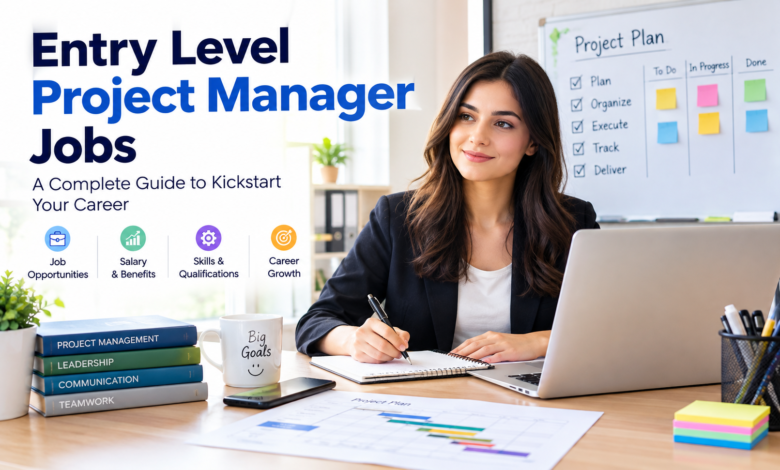
Entry level project manager jobs offer an exciting opportunity for people who want to organize work, coordinate teams, solve problems, and help businesses achieve their goals. These positions are available across industries, including technology, healthcare, construction, marketing, education, finance, and professional services.
Unlike many traditional career paths, project management does not always require years of experience in a single industry. Candidates can enter the field through project coordinator positions, assistant project manager roles, internships, administrative jobs, or opportunities that involve planning and organizing team activities.
For beginners, the most important step is understanding how projects work, which skills employers value, and how to show you can meet deadlines, communicate clearly, and stay organized.
This guide explores entry-level project manager jobs, common responsibilities, qualifications, salary expectations, career opportunities, and practical strategies for landing a first position. It also explains how candidates can build relevant experience even when they have never held the formal title of project manager.
What Are Entry Level Project Manager Jobs?
Entry-level project manager jobs are designed for candidates beginning their careers in project management or transitioning from another professional field. These employees help plan projects, coordinate team members, monitor progress, communicate updates, and ensure that tasks are completed according to established objectives.
Some employers hire junior project managers directly, while others prefer candidates to start as project coordinators or project management assistants. The exact job title depends on the company’s size, industry, and organizational structure.
An entry-level employee may work under a senior project manager who guides scheduling, budgeting, reporting, risk management, and stakeholder communication.
The primary objective is to keep project activities organized and moving forward while learning the processes required to manage larger assignments independently.
What Does an Entry-Level Project Manager Do?
Daily responsibilities vary by employer, but common duties include:
- Creating and updating project schedules.
- Organizing meetings and recording action items.
- Tracking deadlines, milestones, and task completion.
- Communicating updates to team members and supervisors.
- Maintaining project documentation and reports.
- Identifying delays, obstacles, and potential risks.
- Helping manage resources and project budgets.
- Following up with employees or contractors about outstanding tasks.
- Supporting quality checks and project delivery.
For example, a junior project manager working at a marketing agency might coordinate a website redesign. The role could involve tracking content deadlines, arranging meetings between designers and writers, updating the client on progress, and ensuring the website is ready for launch.
In a construction company, the same general role might involve monitoring work schedules, coordinating suppliers, maintaining records, and communicating with site supervisors.
The industries differ, but the underlying responsibilities are similar: organization, communication, accountability, and consistent progress tracking.
Why Entry-Level Project Management Is a Popular Career Choice
Project management combines practical business skills with opportunities for professional growth. It suits people who enjoy working with others, solving organizational problems, and turning plans into measurable results.
Opportunities Across Multiple Industries
Organizations need project managers wherever they introduce new products, improve operations, implement technology, or deliver services.
Entry-level opportunities may be available in:
- Information technology and software development.
- Construction and engineering.
- Marketing and advertising.
- Healthcare administration.
- Banking and financial services.
- Education and nonprofit organizations.
- Manufacturing and logistics.
- Human resources and business operations.
This variety gives beginners flexibility. Someone who starts in marketing project coordination can develop transferable skills that may later support a move into technology, consulting, or business operations.

Transferable Professional Skills
Project management experience can be useful even when an employee eventually chooses a different career path. Scheduling, communication, documentation, problem-solving, and stakeholder management are valuable in many professional environments.
These skills can support progression into operations management, business analysis, product management, program management, and consulting.
A Career With Room to Grow
Entry-level positions can provide a foundation for increasingly responsible assignments. As employees gain experience, they may begin managing projects independently, supervising larger teams, controlling budgets, and coordinating several projects simultaneously.
Progress depends on performance, industry knowledge, organizational opportunities, and project complexity. Promotion isn’t automatic, but a well-developed project management skill set can open several career paths.
Best Entry Level Project Manager Jobs for Beginners
Not every beginner needs to apply for a job titled “project manager.” Several related positions offer a more accessible entry point into the profession.
1. Project Coordinator
A project coordinator supports the administrative and organizational side of project delivery. Responsibilities often include scheduling meetings, tracking tasks, preparing reports, and maintaining documentation.
This position suits recent graduates, administrative professionals, and people moving into project management from customer service or office support.
2. Assistant Project Manager
Assistant project managers work closely with experienced managers to coordinate project activities. They may monitor schedules, communicate with suppliers, review progress reports, and help resolve routine problems.
Some employers require previous industry experience, particularly in construction and engineering, while others consider candidates with relevant education and transferable skills.
3. Junior Project Manager
Junior project managers may oversee smaller projects or manage specific sections of a larger initiative. They are generally expected to understand basic planning, communication, and reporting procedures.
This role suits candidates who have completed internships, managed academic projects, or gained practical coordination experience.
4. Project Management Assistant
Project management assistants help teams maintain organized records, update schedules, prepare meeting materials, and follow established processes.
Although the role may involve less independent decision-making, it provides an opportunity to learn how project teams operate and how managers handle competing priorities.
5. Project Analyst
Project analysts focus on information, reporting, budgets, timelines, and performance measurements. Depending on the employer, the position may require strong spreadsheet skills, analytical thinking, and attention to detail.
Candidates with backgrounds in business, economics, information systems, finance, or data analysis may find this route particularly appealing.
6. IT Project Coordinator
IT project coordinators support technology-related initiatives, including software development, system upgrades, website launches, and infrastructure improvements.
They help coordinate technical teams, maintain task lists, track delivery dates, and communicate progress to stakeholders. Understanding software development processes can be useful, though not every position requires programming knowledge.
7. Construction Project Coordinator
Construction project coordinators assist with schedules, contractor communication, documentation, procurement, and progress tracking.
These positions may require knowledge of construction processes, safety requirements, or technical drawings. An engineering, construction management, or related qualification can be beneficial.
8. Marketing Project Coordinator
Marketing teams use project coordinators to organize campaigns, content production, product launches, and advertising activities.
The role may involve working with graphic designers, copywriters, social media specialists, and external agencies. Candidates with marketing, communications, or digital content experience may have a useful starting advantage.
Education and Qualifications for Entry Level Project Manager Jobs
Educational requirements vary considerably between employers. Some prefer candidates with bachelor’s degrees, while others prioritize practical experience, organizational skills, and industry knowledge.
Do You Need a Degree?
A bachelor’s degree in business administration, project management, management, information technology, engineering, or a related field may improve eligibility for certain positions.
However, a specific project management degree is not universally required. Employers may also consider candidates who have studied communications, marketing, finance, computer science, or other subjects relevant to their projects.
For example, an engineering graduate might be well suited to construction project coordination, while a marketing graduate could pursue campaign coordination or digital project roles.
Candidates without a bachelor’s degree should examine individual job descriptions carefully. Some employers accept equivalent experience or professional training, while others require formal education.
Is Project Management Certification Necessary?
Certification isn’t mandatory for every entry-level role, but it can show that a candidate understands the fundamentals of project management.
One option is the Certified Associate in Project Management (CAPM), offered by the Project Management Institute. It is designed for people developing foundational project management knowledge and does not require prior project management experience. Applicants must meet the relevant education and training requirements, including 23 hours of project management education.
Other learning options include introductory project management courses, Agile fundamentals, and training in commonly used workplace software.
Before paying for a course or certification, review job advertisements in the industry you want to enter. This helps you identify which qualifications employers actually request.
Important Skills Employers Look For
Successful candidates typically demonstrate a combination of technical knowledge and interpersonal skills.
- Organization: Keeping tasks, documents, deadlines, and schedules under control.
- Communication: Sharing clear updates and asking questions when requirements are unclear.
- Time management: Prioritizing urgent work and identifying scheduling conflicts.
- Problem-solving: Recognizing obstacles and helping the team find practical solutions.
- Attention to detail: Maintaining accurate records and checking project requirements.
- Teamwork: Working productively with people who have different responsibilities.
- Adaptability: Adjusting plans when priorities, budgets, or deadlines change.
- Analytical thinking: Understanding project data, identifying patterns, and reporting progress accurately.
Employers may also value familiarity with Microsoft Excel, Microsoft Project, Jira, Trello, Asana, Monday.com, or similar tools. The software used depends on the organization, so beginners should focus on learning transferable concepts rather than attempting to master every platform.
Entry Level Project Manager Salary and Benefits
Salary matters when comparing entry-level project manager jobs, but compensation varies by location, industry, education, employer, and level of responsibility.
In the United States, Indeed’s salary data reported an average annual base salary of about $84,244 for entry-level project managers, based on salary and job-posting data updated October 1, 2026. The same dataset reported a broad range from $57,604 to $123,204. These figures are an indicative market snapshot, not a guaranteed starting salary or a universal range for every employer.
Factors That Influence Salary
Several factors can affect compensation:
- Industry: Technology, engineering, and specialized consulting may offer different compensation structures from nonprofit or administrative environments.
- Location: Salaries can vary significantly between metropolitan areas and smaller markets.
- Experience: Internships, relevant employment, and demonstrable project outcomes may improve a candidate’s position.
- Education and certifications: Relevant qualifications can strengthen an application, but they don’t guarantee higher pay.
- Project complexity: Roles involving budgets, technical requirements, regulatory obligations, or multiple stakeholders may carry greater responsibility.
Benefits may include health insurance, paid leave, retirement contributions, training budgets, and flexible working arrangements. These vary by employer and country.
Candidates applying from Pakistan for US-based remote jobs should distinguish between positions that accept international applicants and those restricted to US residents. A salary advertised for a US employee should not automatically be assumed to apply to an overseas contractor.
How to Get Your First Entry Level Project Manager Jobs
Getting a first project management position is easier when you approach the job search strategically. Don’t rely only on qualifications; build evidence that you can organize work, communicate with a team, and deliver tasks on time.
Step 1: Learn the Fundamentals
Start by understanding the project life cycle: initiation, planning, execution, monitoring, and closure.
Learn basic concepts such as project scope, milestones, deliverables, dependencies, risk registers, and stakeholder communication. You should also understand the difference between traditional project management and Agile approaches.
You do not need to become an expert immediately. A practical understanding of these concepts can help you answer interview questions more confidently.
Step 2: Build Practical Experience
If you have never managed a professional project, create a small portfolio using realistic examples.
You could plan a website launch, organize a community event, develop a marketing campaign, or coordinate a sample product launch. Create a project timeline, task tracker, risk register, and progress report for your chosen example.
Clearly label simulated projects as practice work rather than claiming they were paid professional assignments.
You can also gain experience through internships, volunteering, student organizations, freelance coordination, and responsibilities in your current job.
Step 3: Create a Targeted Resume
A strong resume should highlight relevant achievements rather than list personal qualities.
For example, instead of writing “good organizational skills,” describe how you organized tasks, maintained deadlines, coordinated meetings, or improved a reporting process.
Use measurable results when you have genuine figures available. Never invent percentages, budgets, or project outcomes to make your experience appear more impressive.
Include relevant software, qualifications, industry knowledge, and practical projects. Adjust your resume for each position instead of sending the same generic document to every employer.
Step 4: Search for the Right Job Titles
Search job boards using several related titles:
- Entry Level Project Manager
- Junior Project Manager
- Project Coordinator
- Assistant Project Manager
- Project Administrator
- Project Analyst
- IT Project Coordinator
- Marketing Project Coordinator
- Project Management Intern
These variations matter because employers don’t use a single standard title for all entry-level positions.
Read the full job description before applying. Some roles advertised as entry-level still require several years of experience, while others accept recent graduates or candidates with transferable skills.
Step 5: Prepare for Interviews
Interviewers may ask how you would handle a missed deadline, manage conflicting priorities, communicate with a difficult stakeholder, or respond to a project that exceeds its budget.
Prepare examples using the STAR method: Situation, Task, Action, and Result.
If you have limited professional experience, use relevant examples from university, volunteering, internships, or practice projects. Explain what you did, why you chose that approach, and what you learned.
Employers are often looking for evidence of sound judgment, clear communication, accountability, and a willingness to learn.
Remote Entry Level Project Manager Jobs
Remote project management positions can appeal to candidates who prefer working from home or want to apply for opportunities beyond their local area.
Remote roles exist in software development, digital marketing, consulting, business operations, and other fields. However, fully remote positions may attract applicants from a wider talent pool, increasing competition.
Candidates should build skills in written communication, managing online meetings, shared documentation, and asynchronous collaboration.
A useful remote-work portfolio might include a sample project plan, a weekly status report, a task board, and a short explanation of how you would handle project risks.
People applying internationally should verify the employer’s location requirements, working hours, payment arrangements, employment status, and eligibility rules before accepting an offer.
Be cautious of recruiters who demand upfront payment for a guaranteed job, request sensitive financial information unnecessarily, or offer unrealistic salaries without a credible interview process.
Career Growth After an Entry-Level Project Management Role
An entry-level position can lead to several professional paths, depending on a person’s interests and experience.
From Coordinator to Project Manager
A common route begins with project administration or coordination. Over time, employees may take responsibility for planning, risk management, stakeholder communication, budgets, and project delivery.
Demonstrating reliability and sound decision-making can help an employee earn responsibility for increasingly complex projects.
Moving Into Program or Portfolio Management
Program managers coordinate related projects to achieve broader organizational goals. Portfolio management focuses on selecting and overseeing investments in projects and programs in line with business priorities.
These positions generally require broader experience and a deeper understanding of organizational strategy.
Specializing in a Particular Industry
Some professionals develop expertise in technology, construction, healthcare, finance, or marketing. Industry specialization can make it easier to understand technical requirements, regulatory considerations, and specific stakeholder needs.
The best path depends on whether you prefer technical work, business strategy, creative projects, or operational coordination.
Frequently Asked Questions
1. Can I get an entry level project manager job with no experience?
Yes. Some employers hire candidates without formal project management experience, especially for internships, project assistant roles, and certain coordinator positions. Relevant coursework, transferable skills, practice projects, and a strong resume can improve your chances.
2. What is the easiest project management job to get as a beginner?
Project coordinator, project administrator, project assistant, and project management intern positions are common starting points. The easiest option depends on your education, previous experience, industry knowledge, and the employer’s requirements.
3. How much do entry level project managers earn in the USA?
Indeed reported an average annual base salary of about $84,244 in the United States, based on data updated October 1, 2026. Actual offers can differ considerably by location, industry, and job responsibilities.
4. Do I need a PMP certification for an entry level project manager jobs?
No. A Project Management Professional (PMP) certification is intended for candidates who meet its experience and education requirements. Beginners can instead consider foundational training or the CAPM certification, which does not require prior project management experience.
Project Management Institute
5. Which software should beginners learn?
Start with Excel or Google Sheets for tracking tasks and budgets. Then learn one project management platform, such as Trello, Asana, Jira, or Microsoft Project, based on the industry you want to enter.
6. Can I work remotely as an entry level project manager?
Yes, some companies offer remote and hybrid opportunities. However, availability depends on the employer, industry, time zone, and location restrictions. Beginners should also consider remote project coordinator and project assistant positions.
7. How long does it take to become a project manager?
There is no fixed timeline. Some candidates enter junior roles shortly after graduation, while others first build experience through administration, coordination, or industry-specific positions. Consistent skill development and practical experience can help you progress toward independent project management responsibilities.
Final Thoughts
Entry level project manager jobs offer a practical starting point for people who enjoy planning, teamwork, problem-solving, and delivering results. A formal project management title is not the only way to enter the field; coordinator, assistant, analyst, and administrative roles can also provide valuable experience.
The most effective approach is to learn the fundamentals, build relevant software skills, create a small portfolio, and target positions that match your experience. With continued learning and increasing responsibility, beginners can build a foundation for a long-term career in project management.




One Comment