

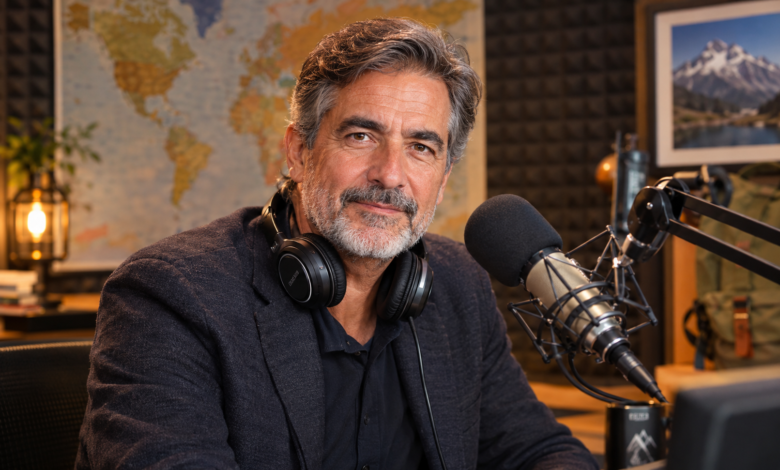
Who Is Paco Grande?
Paco Grande is a Spanish journalist, radio presenter, and media personality best known for his long-running program “Tiempo de Aventura” on Radio Nacional de España (RNE). Over the course of a career spanning several decades, Grande has carved out a distinctive niche in the Spanish media landscape, dedicating his professional life to the world of adventure, exploration, nature, and outdoor pursuits. In a media environment often dominated by politics, entertainment, and sports in the conventional sense, Grande has built a loyal following by turning his microphone toward mountaineers, explorers, ultramarathon runners, divers, and adventurers of every stripe.
“Paco” is the traditional Spanish diminutive of “Francisco,” and it is widely understood that his full given name is Francisco Grande, though he is almost universally known by his shorter, more familiar name in both professional and public contexts. He is recognized not as a tabloid celebrity but as a respected working journalist whose voice has become synonymous with the spirit of exploration in Spanish-language broadcasting.
Early Life and Background
Birth and Origins
Paco Grande was born in Spain, though the precise date and city of his birth are not widely documented in publicly available English-language or mainstream biographical sources. This relative scarcity of personal detail is not unusual for European broadcast journalists, who in many cases maintain a sharper boundary between their professional and private lives than their counterparts in entertainment or reality television. What is known is that Grande came of age during a period of significant transformation in Spanish media, as the country transitioned from the tightly controlled broadcasting environment of the late Franco era into the vibrant, pluralistic media landscape of democratic Spain in the 1980s and 1990s.
Family and Upbringing
Detailed information about Paco Grande’s parents, siblings, and extended family has not been prominently featured in public interviews or press profiles. Grande has generally kept the focus of his public appearances on the subjects of his reporting — the adventurers and explorers he interviews — rather than on his own personal history. This editorial choice reflects a broader tradition in European journalism, where the reporter’s role is seen as that of a conduit for other people’s stories rather than a protagonist in their own right.
Education and Early Career
Specific details regarding Grande’s formal education, including the universities he attended or the degrees he earned, are not extensively documented in widely accessible sources. However, his career trajectory suggests a strong foundation in journalism and communications, likely supplemented by a deep personal passion for the outdoors and adventure sports that would later define his professional identity.
Like many Spanish journalists of his generation, Grande likely began his career in local or regional media before working his way into the national broadcasting system. Spain’s public broadcasting infrastructure, anchored by Radiotelevisión Española (RTVE) and its radio arm RNE, has long served as a training ground and career destination for the country’s most dedicated broadcast professionals. Grande’s eventual rise within this system speaks to both his journalistic skill and his ability to identify and cultivate an underserved audience.
Rise to Prominence at Radio Nacional de España
Joining RNE
Radio Nacional de España is the country’s flagship public radio network, with a history stretching back to the 1930s. By the time Paco Grande became associated with the network, RNE had established itself as a cornerstone of Spanish cultural life, offering a diverse range of programming that included news, classical music, cultural commentary, and specialty shows. Grande found his home within this ecosystem, eventually becoming one of the network’s most recognizable specialty presenters.
His association with RNE gave him access to a national audience and the institutional support necessary to produce a program of the scope and ambition that “Tiempo de Aventura” would eventually achieve. Public radio in Spain has traditionally allowed for more niche programming than commercial stations, and Grande leveraged this freedom to build a show that would have struggled to find airtime in a purely ratings-driven environment.
The Birth of “Tiempo de Aventura”
“Tiempo de Aventura” (which translates roughly to “Adventure Time” or “Time for Adventure”) is the program most closely associated with Paco Grande’s name and legacy. The show is dedicated to the world of adventure in its broadest sense: high-altitude mountaineering, polar expeditions, ocean crossings, ultramarathon running, cave exploration, wildlife conservation, and the full spectrum of human endeavor at the outer edges of physical and geographical possibility.
The program typically features in-depth interviews with adventurers, athletes, scientists, and explorers, often recorded in a conversational format that allows guests to tell their stories at length. Grande’s interviewing style is characterized by genuine curiosity, careful preparation, and a palpable enthusiasm for his subject matter that resonates with listeners. Rather than treating adventure as a mere spectacle, “Tiempo de Aventura” tends to explore the psychological, philosophical, and human dimensions of extreme endeavor, asking not just what his guests accomplished but why they felt compelled to attempt it in the first place.
Career Highlights and Professional Achievements
Covering the World’s Greatest Adventures
Over the years, “Tiempo de Aventura” has featured a remarkable roster of guests, including some of the most accomplished mountaineers, sailors, explorers, and endurance athletes in the Spanish-speaking world and beyond. The program has covered landmark expeditions to the Himalayas, the Arctic, the Amazon, and other remote corners of the globe, often providing Spanish audiences with their first in-depth exposure to stories that might otherwise have gone unreported in the national media.
Grande’s work has been particularly significant in elevating the profile of Spanish and Latin American adventurers, many of whom have achieved extraordinary feats without receiving the mainstream media attention afforded to footballers or pop stars. By giving these individuals a national platform, Grande has played a meaningful role in broadening the Spanish public’s understanding of what athletic and exploratory achievement can look like.
Awards and Recognition
While specific award details are not comprehensively catalogued in widely available sources, Grande’s longevity on the air and the sustained loyalty of his audience are themselves a form of recognition in the competitive world of Spanish broadcasting. Maintaining a niche program on a national network for an extended period is no small feat, and it speaks to the quality and consistency of his work.
Personal Life
Relationships and Family
Paco Grande has maintained a notably private personal life throughout his career. Reliable public information about a spouse, partner, or children is not readily available in mainstream sources. This discretion appears to be a deliberate choice rather than an oversight, consistent with his overall approach to public life, which prioritizes the stories of others over his own.
Interests Beyond the Microphone
Given the subject matter of his program, it is reasonable to infer that Grande has a deep personal interest in the outdoors, travel, and physical activity, though the specific details of his hobbies and pursuits outside of work are not extensively documented. His encyclopedic knowledge of adventure sports and exploration, evident in his broadcasts, suggests a level of personal engagement with these topics that goes well beyond professional obligation.
Net Worth and Financial Standing
Reliable estimates of Paco Grande’s net worth are not publicly available. As a public radio journalist in Spain, his compensation would be structured according to the salary scales of RTVE, the state broadcasting corporation. Public broadcasting salaries in Spain are generally modest compared to those in commercial television or entertainment, and Grande is not known to have pursued significant commercial endorsements or business ventures outside of his radio work. His wealth, to the extent that it can be assessed, is likely the product of a steady, long-term career in public media rather than high-profile commercial success.
Social Media and Public Presence
Paco Grande maintains a relatively low-key social media presence compared to many contemporary media figures. “Tiempo de Aventura” has been promoted through RNE’s official digital channels, and Grande has participated in public events, book fairs, and adventure festivals in Spain. However, he does not appear to cultivate the kind of high-volume, personality-driven social media following that has become standard for many broadcasters of his generation. His public appearances tend to be connected to his professional work — moderating panels, introducing speakers at adventure film festivals, or participating in outdoor events — rather than to self-promotion in the conventional influencer sense.
Life Today and Current Projects
Paco Grande continues to be associated with the world of adventure journalism in Spain. “Tiempo de Aventura” has enjoyed a remarkably long run by the standards of specialty radio programming, and Grande’s voice remains a familiar presence for listeners who tune in for their regular dose of exploration and outdoor storytelling. The program has adapted over the years to changes in the media landscape, including the rise of podcasting and on-demand audio, which have allowed new audiences to discover the show’s extensive archive of interviews and features.
Legacy and Impact on Spanish Media
Paco Grande’s most enduring contribution to Spanish media may be his demonstration that there is a substantial and devoted audience for thoughtful, long-form journalism about the natural world and human exploration. In an era when media attention spans have grown ever shorter and the pressure to chase viral content ever more intense, Grande has maintained a program that rewards patience, curiosity, and a willingness to listen to stories that unfold over hours rather than seconds.
His work has helped normalize the idea that adventure and exploration are worthy subjects for serious journalistic treatment, not merely fodder for sensationalist television or social media clips. For a generation of Spanish listeners, “Tiempo de Aventura” has been a window onto a wider world, a source of inspiration, and a reminder that the human capacity for endurance, curiosity, and wonder remains as vital as ever.





One Comment