Growth Navigate Funding: A Complete Guide to Business Growth, Capital and Financial Strategy

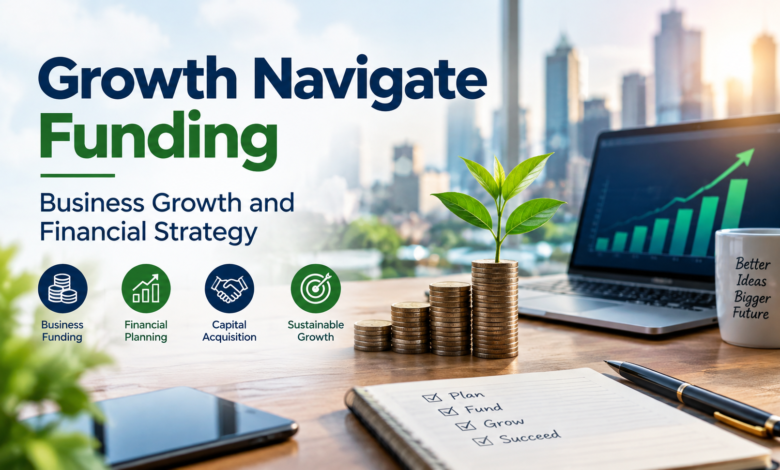
Growth Navigate Funding is a term increasingly used to describe the challenge of helping businesses secure capital while building a sustainable path to long-term growth. For startups, small businesses, and established companies, funding is rarely just about finding money. The more important question is how much capital is needed, where it should come from, how it will be used, and whether the financing structure supports the company’s future.
The phrase can also refer to businesses operating under the Growth Navigate name that offer funding, financial advisory, business coaching, and growth-related services. Because several similarly named websites exist, it is important to distinguish between a general funding strategy and a particular commercial advisory business.
Unlike a celebrity or public personality, Growth Navigate Funding has no conventional biography. No meaningful public record links the term to a birth date, childhood, parents, spouse, or children. Instead, its story is best understood through the development of business funding, financial planning, and growth advisory services.
What Is Growth Navigate Funding?
Growth Navigate Funding can be understood in two related ways.
First, it describes a strategic approach to business funding in which companies match their financing decisions with their stage of development, financial position, growth objectives, and operational needs.
Second, Growth Navigate is also used as the name of commercial advisory businesses that promote services designed to help companies obtain capital, improve financial systems, manage cash flow, and scale.
This distinction matters because the term is sometimes presented as a single government grant, loan, or standardized financial program. There is no reliable basis for treating “Growth Navigate Funding” as one universal government funding scheme.
For business owners, the practical meaning is simpler: funding should support a clearly defined business objective, not just provide cash.
The Story Behind Growth Navigate
The broader idea behind Growth Navigate comes from a common problem entrepreneurs face. A company can have a promising product, strong customer demand, or an experienced team and still struggle if it manages its finances poorly.
Growth requires money for many different reasons. A company might need capital to hire employees, purchase equipment, develop technology, increase inventory, enter another market, expand marketing, or maintain operations while revenue catches up with expenses.
The challenge is that raising too little money can leave a company undercapitalized, while raising too much can create unnecessary debt, dilution, or financial pressure.
Growth Navigate’s publicly described approach focuses on connecting funding with business growth. Its services focus on capital acquisition, financial planning, business coaching, investment strategy, risk management, and financial technology.
Why Funding and Growth Must Work Together
A funding round by itself does not create a successful company.
Capital helps when it enables a business to reach a measurable milestone. For example, a startup might use funding to develop its first commercially viable product. A growing company might use financing to hire a sales team or expand into a new geographic market.
The objective is to make the relationship between money and growth understandable.
A strong funding plan therefore asks several basic questions:
- How much capital does the company actually need?
- What will the money be used for?
- How long will it last?
- What business milestone should it help achieve?
- Will the financing create debt or ownership dilution?
- What happens if growth takes longer than expected?
These questions can be more important than the headline size of the funding round.
Growth Navigate Funding Services
Businesses operating under the Growth Navigate name describe a range of services designed to help entrepreneurs improve their financial position and pursue expansion.
Business Funding and Capital Acquisition
A central focus is helping businesses identify potential capital sources.
Depending on the company and its stage, possible sources can include venture capital, angel investors, business loans, revenue-based financing, private investment, or internally generated cash.
The appropriate option depends heavily on the business model.
A technology startup with rapid growth potential may be more suited to equity investment, while an established company with predictable revenue might consider debt financing.
Business Coaching and Financial Advisory
Funding is only one part of financial management.
Businesses also need systems that show where money is being generated and where it is being spent. Financial advisory services can involve budgeting, cash-flow planning, profitability analysis, capital allocation, and broader growth strategy.
For a business owner, the goal is not simply to increase revenue. Sustainable growth requires the company to understand its costs and preserve enough cash to continue operating.
Financial Planning and Risk Management
Cash flow is one of the biggest challenges for growing businesses.
A company can appear successful on paper while still experiencing periods when expenses arrive before customer payments. Poor cash-flow planning can force an otherwise healthy business to seek emergency financing.
Financial planning reduces that risk by forecasting income, expenses, financing needs, and potential financial pressures.
Risk management also becomes more important as companies grow. Larger operations typically have more employees, suppliers, contracts, customers, and financial obligations.
Investment Strategy and Wealth Building
Growth Navigate also presents investment strategy as part of its broader financial approach.
For entrepreneurs, building wealth can eventually become a separate issue from operating a company. Business owners may need to think about how profits are retained, reinvested, diversified, or allocated outside the company.
The right strategy varies by individual circumstances, business structure, risk tolerance, and financial objectives.
How Growth Navigate Funding Can Work for Startups
Startups generally progress through different funding stages.
Pre-Seed Stage
At the earliest stage, founders may rely on personal savings, friends and family, early customers, grants, or angel investors.
The primary objective is often proving that the business idea can become a viable product or service.
At this point, large amounts of outside capital may not always be necessary. Demonstrating demand can be more valuable than raising a large round.
Seed Funding
Once a company has a product and early evidence of market demand, it may seek seed funding.
Seed capital can support product development, hiring, marketing, customer acquisition, and operational infrastructure.
Investors typically want to understand how the company plans to convert the new capital into measurable growth.
Series A and Beyond
More established startups may pursue Series A, Series B, and later financing rounds.
At these stages, investors generally expect stronger evidence of market opportunity, customer traction, revenue potential, management capability, and scalability.
The amount of capital required may increase significantly, but so do expectations surrounding financial reporting and business performance.
The Importance of a Strong Pitch
A business seeking outside funding needs to communicate its opportunity clearly.
A pitch deck typically explains the problem the company addresses, its solution, target market, business model, competitive landscape, traction, team, financial expectations, and funding requirements.
However, a polished presentation cannot compensate for weak fundamentals.
Investors may examine customer acquisition costs, revenue growth, margins, retention, competition, intellectual property, cash burn, and the assumptions behind financial projections.
This is why funding strategy and financial preparation need to work together.
Is Growth Navigate Funding a Government Grant?
One of the most important points for people searching for Growth Navigate Funding is that the phrase should not automatically be interpreted as a government grant.
Online discussions and articles sometimes use funding terminology loosely, which can make a commercial advisory service seem like a public funding program.
Businesses should verify the identity of any organization offering financing and understand exactly what is being offered before providing financial information or paying fees.
A legitimate funding arrangement should clearly explain its terms, costs, eligibility requirements, obligations, and expected process.
Entrepreneurs should be particularly cautious of anyone promising guaranteed investment or guaranteed loan approval.
Growth Navigate and Its Publicly Described Team
Public information associated with GrowthNavigate.com identifies professionals including Samantha Steele, described as Director of Financial Strategy, and Sayush Khandelwal, described as Head of Finance & Tech.
Their publicly presented roles focus on financial planning, capital allocation, fintech, investment strategy, cash flow, and financial technology.
However, the public material reviewed does not establish traditional biographical details such as exact age, birthplace, parents, childhood, spouse, or children. Do not invent those details to fit a celebrity-style biography format.
Separate websites also use names such as Growth Navigate Funding, so readers should verify the exact organization they are researching.
Growth Navigate Funding and Business Growth
The central idea behind growth-oriented funding is that capital should have a purpose.
A company that raises money without a clear plan can increase its expenses without solving its underlying problems. More employees, advertising, technology, and office space can accelerate losses if the business model has not been proven.
A disciplined funding strategy works differently.
The company first identifies its most important growth constraint. It then estimates the capital needed to address that constraint and determines the most appropriate type of financing.
For example, a company with strong demand but insufficient inventory may require working capital. A software startup developing a new platform may require equity investment. An established business with predictable cash flow may find a conventional loan more appropriate.
The funding decision should follow the business requirement rather than the other way around.
Net Worth and Financial Position
Growth Navigate Funding has no reliable personal “net worth” because it is not an individual celebrity.
Likewise, publicly available information does not provide a sufficiently established corporate valuation to present as the organization’s official net worth.
Figures promoted by individual Growth Navigate-related websites, such as amounts of capital supposedly secured for clients or numbers of startups served, should be treated as company-reported claims unless independently verified.
This distinction is especially important when researching financial services.
Public Presence and Social Media
Growth Navigate’s public presence is primarily business-oriented rather than personality-driven.
Its online material focuses on funding, financial planning, business growth, technology, investment strategy, and entrepreneurial advice.
Because the term “Growth Navigate” appears across multiple websites, social-media accounts, and online profiles, they should check carefully to ensure they belong to the intended organization.
No single, universally recognized public personality behind the phrase has a social-media presence that defines Growth Navigate Funding.
Life Today: What Growth Navigate Funding Represents
Today, Growth Navigate Funding is best understood as a phrase tied to modern business finance and growth strategy rather than the biography of a single person.
For entrepreneurs, the most useful lesson is that obtaining capital is only one stage of building a company.
A business needs a reason to raise money, a realistic financial model, an appropriate financing structure, and a plan to turn capital into measurable progress.
Growth Navigate’s broader philosophy reflects this connection between funding and sustainable growth. Whether a company is seeking its first outside investment or attempting to scale an established operation, financial decisions can influence ownership, cash flow, risk, and long-term stability.
The strongest funding strategy is therefore not necessarily the one that produces the largest cheque. It is the one that gives the business enough resources to reach its next important milestone without creating an unsustainable financial burden.
Frequently Asked Questions
What is Growth Navigate Funding?
Growth Navigate Funding generally refers to the process of strategically obtaining and managing capital for business growth. It can also refer to commercial advisory businesses operating under the Growth Navigate name.
Is Growth Navigate Funding a government grant?
There is no reliable evidence that “Growth Navigate Funding” is a single government grant program. The phrase is also used for private business advisory and funding services.
Who founded Growth Navigate?
Publicly available information does not provide enough verified founder information to present a complete biography confidently. Several similarly named businesses also exist, so accurate identification is important.
What services does Growth Navigate provide?
Services publicly associated with Growth Navigate include business funding and capital acquisition, financial advisory, financial planning, risk management, investment strategy, business coaching, and fintech-related solutions.
Can startups use Growth Navigate for funding?
The Growth Navigate business model is presented as supporting companies seeking capital and growth assistance. However, entrepreneurs should evaluate the exact provider, fees, financing terms, and funding claims before entering an agreement.
Does Growth Navigate guarantee funding?
Businesses should never assume that an advisory service can guarantee investment or loan approval. Funding decisions ultimately depend on investors, lenders, eligibility requirements, business performance, and other factors.
What should a business consider before seeking funding?
A company should understand how much money it needs, what the capital will finance, how long it will last, what milestone it should achieve, and whether debt or equity financing is appropriate. A realistic financial plan is essential before accepting outside capital.