
Famous Blind People: Inspiring Lives, Remarkable Achievements, and Powerful Stories

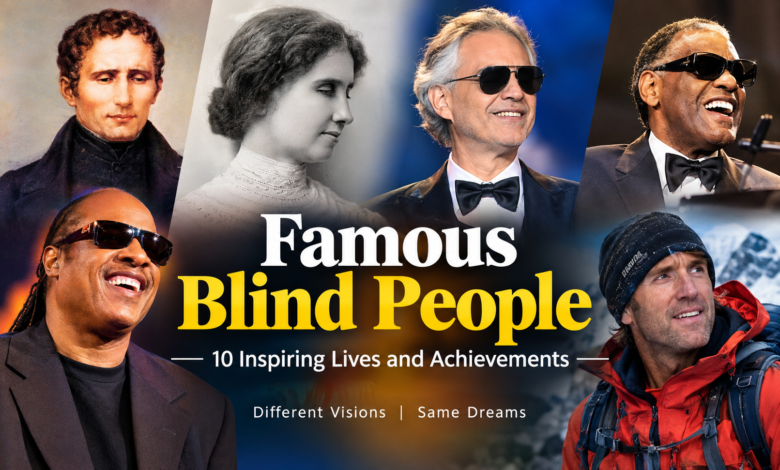
Throughout history, many people who were blind or visually impaired have made extraordinary contributions to education, literature, music, science, sports, politics, and entertainment. Their achievements demonstrate that vision is only one way of experiencing the world and that talent, determination, education, and opportunity can shape a person’s future in remarkable ways.
Some famous blind people lost their sight during childhood, while others were born blind or experienced progressive vision loss later in life. Despite facing barriers to education, employment, and social acceptance, many became internationally recognized figures whose work influenced millions of people.
Among the best-known examples are Helen Keller, a writer and disability rights advocate; Louis Braille, the inventor of the Braille reading and writing system; Andrea Bocelli, the celebrated Italian tenor; Ray Charles, the influential American musician; and Marla Runyan, a visually impaired athlete who competed at the highest levels of international sport.
Their stories are different, but famous blind people share an important theme: blindness does not define the entirety of a person’s abilities, identity, or potential. Understanding their lives also provides a broader perspective on accessibility, disability rights, and the importance of creating opportunities for people with different needs.
What Does It Mean to Be Blind?
Blindness describes a range of visual conditions. Some people have no functional vision, while others can distinguish light, shapes, or objects but face significant limitations in everyday visual tasks. People with low vision may also identify with the broader blind community, depending on their circumstances and preferences.
Blindness can be present at birth, develop during childhood, or occur later because of illness, injury, or other medical conditions. The experience varies considerably from one individual to another.
For famous blind people, public recognition often focuses on achievements rather than the practical realities of living with a visual disability. Their experiences can include learning alternative reading methods, navigating unfamiliar environments, using assistive technology, and challenging assumptions about what blind people can accomplish.
Helen Keller: Writer, Educator, and Disability Rights Advocate
Early Life and Family Background
Helen Adams Keller was born on June 27, 1880, in Tuscumbia, Alabama, United States. She became one of the most influential deafblind people in modern history, gaining international recognition as an author, lecturer, and advocate for people with disabilities.
Her parents were Arthur Henley Keller, a newspaper editor and former Confederate Army officer, and Katherine Adams Keller. Helen initially developed normally, but an illness when she was approximately 19 months old left her both deaf and blind. The exact illness has never been conclusively established.
Her early inability to communicate made childhood extremely difficult. Without an accessible language system, she struggled to express her needs and understand the people around her.
Education and Anne Sullivan’s Influence
A turning point came in 1887, when Anne Sullivan arrived to teach Helen. Sullivan introduced a method of spelling words into Keller’s hand, helping her connect tactile patterns with objects and ideas.
The famous moment involving water flowing over Keller’s hand became a defining episode in her life because it helped her understand that the hand-spelled word represented something real.
Keller continued her education and attended Radcliffe College, graduating with a Bachelor of Arts degree in 1904. She became the first deafblind person widely recognized as having earned a college degree.
Career and Major Achievements
Keller wrote books, delivered lectures, and campaigned for disability rights, education, women’s rights, and social reform. Her autobiography, The Story of My Life, published in 1903, remains an important account of her education and personal development.
She worked with organizations supporting famous blind people and became involved in the American Foundation for the Blind. Her international travels brought attention to the educational and social barriers experienced by people with disabilities.
Keller also supported political and social causes beyond disability advocacy, including women’s suffrage and labor reform. Her activism reflected a broad belief that access to education and public life should not depend on a person’s physical abilities.
Personal Life and Legacy
Keller never married and had no children. Her closest personal and professional relationships included her lifelong connection with Anne Sullivan, whose teaching helped transform her life.
Keller died on June 1, 1968, at her home in Easton, Connecticut, aged 87. Her legacy continues through her writings, educational programs, and the international recognition of her role in disability advocacy.
Her exact net worth is not reliably established, and modern social media accounts should not be confused with the historical figure’s own activities.
Louis Braille: The Inventor Who Changed Reading Forever
Birth, Childhood, and Education
Louis Braille was born on January 4, 1809, in Coupvray, France. His father, Simon-René Braille, worked as a leatherworker and harness maker, while his mother was Monique Baron. Louis grew up in a working family with siblings.
At approximately three years old, Braille injured one eye while playing in his father’s workshop. An infection subsequently affected the other eye, and he became completely blind during early childhood.
Despite his disability, Braille demonstrated considerable intellectual ability. He received an education at the Royal Institute for Blind Youth in Paris, where he studied alongside other blind students.
Developing the Braille System
At the school, students encountered significant difficulties accessing printed books. Existing methods of producing raised letters were often cumbersome, expensive, and difficult to read by touch.
Braille developed a system based on combinations of raised dots that could represent letters, numbers, and other symbols. His approach drew inspiration from a tactile code associated with Charles Barbier, a French military officer who had developed a system for communicating silently at night.
Braille refined the concept into a practical reading and writing method. His system was published in the 1820s and later expanded to accommodate music notation and additional uses.
The system eventually became known worldwide as Braille. It transformed literacy for famous blind people by providing a more efficient way to read and write independently.
Career and Lasting Impact
Braille worked as a teacher at the institute where he had studied. Although his invention was not universally adopted during his lifetime, it gradually became a central part of blind education.
Today, Braille is used in books, educational materials, public signage, and other accessible formats. Digital Braille displays also allow people to read electronic text through refreshable tactile cells.
Braille never married and had no known children. He died on January 6, 1852, in Paris, two days after his 43rd birthday. His personal net worth is not reliably documented.
His influence extends far beyond France. By making written communication more accessible, Louis Braille helped create opportunities for generations of blind readers, students, professionals, and writers.
Andrea Bocelli: The Blind Tenor Who Conquered the World
Early Life and Family
Andrea Bocelli was born on September 22, 1958, in Lajatico, Tuscany, Italy. His parents, Alessandro and Edi Bocelli, raised him in a family connected to agricultural work and small business.
Bocelli was born with congenital glaucoma, a condition that affected his eyesight from infancy. He experienced substantial vision difficulties throughout childhood and became completely blind at age 12 after a football accident caused a cerebral hemorrhage.
Music was already an important part of his life. As a young boy, he learned to play instruments and developed a strong interest in opera and classical singing.
Education and Musical Development
Bocelli studied piano, flute, saxophone, trumpet, trombone, guitar, and drums. His musical training helped him develop a broad understanding of melody and performance.
He also studied law at the University of Pisa and qualified as a lawyer. Before achieving widespread musical success, he worked briefly in the legal profession and performed in piano bars.
His early career demonstrates that his eventual success was not an overnight achievement. He spent years developing his voice, studying music, and performing for audiences before the international recording industry recognized his talent.
International Career
Bocelli’s career gained significant momentum in the early 1990s. His recordings and performances brought classical singing to audiences who might not otherwise have explored opera.
He achieved worldwide popularity through recordings such as Romanza and songs including “Con te partirò.” The English-language version, “Time to Say Goodbye,” became especially popular through his collaboration with soprano Sarah Brightman.
Over the following decades, Bocelli performed at major concert venues and international events. His repertoire includes opera arias, classical works, and popular crossover music.
He has collaborated with artists from different musical genres, helping introduce operatic vocals to a broader audience.
Wife, Children, and Personal Life
Bocelli married Enrica Cenzatti in 1992. famous blind peoplemThey had two sons, Amos and Matteo, before divorcing in 2002. In 2014, he married Veronica Berti, with whom he has a daughter, Virginia.
His family has occasionally appeared alongside him in musical performances and public events. His son Matteo Bocelli has also pursued a singing career.
Bocelli continues to perform internationally. Although estimates of his net worth vary among entertainment publications, no universally verified public figure establishes his exact wealth.
He is an example of a musician whose success rests on years of training, vocal ability, and performance experience rather than on sight.
Ray Charles: The Blind Musician Who Transformed American Music
Early Life and Family
Ray Charles Robinson was born on September 23, 1930, in Albany, Georgia, United States. He grew up primarily in Greenville, Florida, in a family that experienced considerable financial hardship.
His mother, Aretha Williams, played a major role in raising him. His father, Bailey Robinson, was largely absent from his upbringing. Charles developed an interest in music as a child and learned to play the piano.
He began losing his sight at a young age and became completely blind by approximately age seven. The precise medical cause is not conclusively established, although glaucoma is frequently mentioned in accounts of his life.
Music Career and Achievements
Charles attended the Florida School for the Deaf and the Blind in St. Augustine, where he studied music and learned Braille. After his mother’s death during his teenage years, he began supporting himself through musical work.
His professional career developed through performances in clubs and recordings that combined gospel, blues, jazz, rhythm and blues, and country influences. His distinctive voice and innovative arrangements helped shape what became known as soul music.
Songs such as “Georgia on My Mind,” “Hit the Road Jack,” and “What’d I Say” became enduring classics. His influence reached musicians across multiple genres, and he earned numerous awards during his career, including Grammy Awards.
Family, Personal Life, and Legacy
Charles had several children with different partners and was married twice, first to Eileen Williams and later to Della Beatrice Howard Robinson. His family life was complex, and accounts of his relationships should be distinguished from the well-documented achievements of his musical career.
He died on June 10, 2004, in Beverly Hills, California, at age 73, following complications associated with liver disease.
Although estimates of his wealth differ, his exact net worth at death is not definitively established. His recordings continue to reach new audiences, and his contribution to American music remains substantial.
Marla Runyan: A Visually Impaired Athlete Who Made History
Childhood and Education
Marla Runyan was born on January 4, 1969, in Santa Maria, California, United States. She developed a progressive visual impairment associated with Stargardt disease, an inherited condition that affects central vision.
Despite her visual limitations, Runyan became an accomplished athlete. She attended San Diego State University, where she participated in track and field and established herself as a talented competitor.
Her experience demonstrates that athletic performance depends on a range of abilities, including endurance, discipline, training, and tactical awareness. Visual impairment can create additional challenges, but it does not automatically prevent someone from competing at an elite level.
Sporting Career and Olympic Achievements
Runyan gained international attention through her participation in Paralympic competition. At the 1992 Summer Paralympics in Barcelona, she won medals in multiple events, demonstrating her ability across different athletic disciplines.
She subsequently competed in mainstream elite athletics, an achievement that distinguished her career. Runyan represented the United States in the women’s 1,500-meter event at the 2000 Summer Olympics in Sydney, becoming widely recognized as the first legally blind athlete to compete in the Olympic Games.
Her participation challenged traditional assumptions about visual disability and elite sports. It also brought greater attention to the importance of inclusive sporting opportunities.
Personal Life and Legacy
Runyan married fellow athlete Matt Runyan. She has generally maintained a more private personal life than many entertainment celebrities, and detailed information about her parents, siblings, and personal finances is not consistently available in reliable public records.
Her exact net worth is not publicly verified. Her legacy is primarily connected to athletics, disability inclusion, and her achievements in both Paralympic and Olympic competition.
Runyan’s story highlights the importance of distinguishing blindness from overall athletic ability and recognizing the individual adaptations that different competitors may use.
Erik Weihenmayer: The Blind Adventurer Who Climbed Everest
Early Life and Education
Erik Weihenmayer was born on September 23, 1968, in Princeton, New Jersey, United States. He lost his sight because of a rare eye disease, retinoschisis, which progressively damaged his vision during childhood. He became completely blind at approximately age 13.
Rather than abandoning outdoor activities, Weihenmayer pursued climbing, hiking, and adventure sports. He learned to navigate using tactile information, sound, communication with climbing partners, and other techniques adapted to his circumstances.
He later attended Boston College, where he developed interests beyond athletics and began building a career that combined adventure, public speaking, and disability advocacy.
Climbing Mount Everest
Weihenmayer became internationally known in 2001 when he reached the summit of Mount Everest. His achievement made him the first blind person widely recognized for successfully climbing the world’s highest mountain.
The expedition demanded extensive physical preparation, careful route planning, technical climbing skills, and teamwork. Blindness introduced additional navigational challenges, particularly on dangerous terrain where visual cues ordinarily help climbers identify hazards.
His accomplishment attracted international attention because it challenged assumptions about disability and extreme adventure. However, his success also reflected the contributions of experienced guides, teammates, and support personnel.
Family and Work Today
Weihenmayer is married to Ellen Weihenmayer, and famous blind people have children. He has written books about his experiences, including Touch the Top of the World, and has worked as a motivational speaker and advocate for people with disabilities.
He also helped establish organizations focused on adaptive adventure and outdoor experiences, including initiatives designed to help people overcome physical and social barriers.
His exact net worth is not reliably confirmed through authoritative public records. His public profile is based primarily on mountaineering, writing, speaking, and advocacy rather than traditional celebrity entertainment.
Stevie Wonder: A Musical Legend Born Blind
Early Life and Musical Talent
Stevie Wonder was born Stevland Hardaway Judkins on May 13, 1950, in Saginaw, Michigan, United States. His name later became Stevland Hardaway Morris following changes in his family circumstances.
He was born prematurely and developed retinopathy of prematurity, a condition that can damage the retina. He became blind during infancy.
Wonder demonstrated musical talent at a young age and learned to play several instruments, including piano, harmonica, and drums. His family supported his musical interests, and his ability attracted attention while he was still a child.
Career and International Recognition
Wonder signed with Motown’s Tamla label as a young performer and quickly established himself as a recording artist. Over time, he developed from a child singer into an influential songwriter, instrumentalist, and producer.
His best-known songs include “Superstition,” “Isn’t She Lovely,” and “I Just Called to Say I Love You.” Albums such as Songs in the Key of Life helped establish his reputation as one of the most important figures in popular music.
Wonder has received numerous awards, including multiple Grammy Awards. His work has influenced generations of musicians through its combination of soul, funk, pop, and innovative studio techniques.
Family and Personal Life
Wonder has been married several times and has children. His family includes musicians and individuals who have occasionally appeared with him at public events.
He has also participated in charitable and social causes, including campaigns addressing hunger, equality, and disability rights. His personal wealth is frequently estimated by entertainment publications, but those estimates should not be treated as verified financial statements.
Wonder’s career demonstrates that blindness does not prevent a person from becoming a technically accomplished musician, a creative leader, or a major cultural influence.
How Famous Blind People Have Changed Society
The achievements of these individuals extend beyond personal success. Their work has helped change how blindness is understood in education, employment, culture, and public life.
Louis Braille’s tactile writing system made independent reading more accessible. Helen Keller’s public advocacy helped challenge exclusion from education and civic participation. Andrea Bocelli, Ray Charles, and Stevie Wonder have demonstrated the enormous cultural contributions of blind musicians.
famous blind people, Erik Weihenmayer and Marla Runyan have also challenged assumptions about physical activity and competitive sport. Their accomplishments show why accessible environments, appropriate support, and equal opportunities matter.
At the same time, these success stories should not create the impression that every blind person must accomplish something extraordinary to deserve respect. Ordinary life, employment, relationships, education, and independence are equally meaningful.
Modern accessibility tools—including screen readers, refreshable Braille displays, audio navigation, and accessible digital services—continue to expand opportunities. However, inaccessible websites, inadequate educational support, and employment discrimination remain challenges in many parts of the world.
Frequently Asked Questions About Famous Blind People
1. Who is the most famous blind person in history?
Helen Keller is among the most widely recognized blind and deafblind people in history. Her writing, education, and disability advocacy earned her international recognition.
2. Who invented Braille?
Louis Braille, a French educator who became blind during childhood, developed the tactile reading and writing system known as Braille. His invention transformed literacy and education for famous blind people.
3. Which famous singers are blind?
Stevie Wonder, Ray Charles, and Andrea Bocelli are among the best-known blind musicians. Their careers span soul, rhythm and blues, pop, classical music, and opera.
4. Has a blind person climbed Mount Everest?
Yes. Erik Weihenmayer reached the summit of Mount Everest in 2001, becoming the first blind person to achieve this widely documented mountaineering milestone.
5. Can blind people compete in the Olympic Games?
Yes. Marla Runyan competed in the 2000 Summer Olympics in Sydney. Her participation demonstrated that athletes with visual impairments can compete in mainstream elite sports.
6. How do blind people read and use computers?
Blind people may use Braille, screen readers, audio interfaces, keyboard navigation, and other assistive technologies. The most suitable method depends on the individual’s vision, preferences, and daily needs.
7. What can we learn from famous blind people?
Their lives demonstrate the importance of education, accessibility, persistence, individual talent, and equal opportunity. Famous blind people also remind us that blindness is one aspect of a person’s life, not a complete definition of their abilities or identity.
Conclusion
The stories of famous blind people reveal a broad range of human achievements. From Helen Keller’s advocacy and Louis Braille’s invention to the musical success of Stevie Wonder, Ray Charles, and Andrea Bocelli, these individuals have influenced millions through their work.
Erik Weihenmayer’s mountaineering accomplishments and Marla Runyan’s athletic career further illustrate how people with visual impairments can pursue challenging goals in very different fields.
Famous blind people legacies are not simply stories about overcoming blindness. famous blind people are also stories about creativity, education, determination, accessible opportunities, and the value of recognizing people for their individual contributions.
As technology and public awareness continue to develop, the experiences of these remarkable individuals remain relevant. Famous blind people encourage society to remove unnecessary barriers, expand access to education and employment, and recognize that human potential cannot be measured by eyesight alone.



One Comment